How Much Does Website SEO Cost After Development?

Launching a technically clean website is not the same as completing SEO. Development can make pages crawlable, fast and well structured, but competitive organic growth usually requires research, useful content, internal linking, reputation and ongoing iteration. That is why business owners often ask how much SEO costs after the website is developed. The answer depends on competition, geography, the number of services, existing authority and how much content or outreach is required.
Table of Contents
- Development SEO vs Ongoing SEO
- Why SEO Pricing Varies by Competition
- Content Quality Is a Real Cost
- What a Good Scope Should Include
- Mobile UX and Page Experience
- SEO and Crawlability
- Performance and Engineering Quality
- Content, Proof and Trust
- Hidden and Recurring Costs
- Ownership and Handover
- How to Compare Providers
- Audit the Current Situation Before Spending
- Prepare Inputs Before the Project Starts
- Define Measurement Before Launch
- Launch QA Checklist
- What to Do in the First 90 Days
- Common Mistakes
- Decision Framework
- Final Takeaway
- SEO Budget Should Follow the Revenue Opportunity
- Content Refresh Is Part of SEO Cost
- Developer Capacity May Be Required for SEO
- Authority Building Should Be Earned, Not Manufactured
- Reporting Should Drive Decisions
- SEO Compounds When Website and Content Teams Share One Map
- SEO Retainers Should Include Prioritisation, Not Just Output Quotas
- Use Search Console to Build an Improvement Queue
- Brand Search Is Part of SEO Too
- Frequently Asked Questions
Typical SEO Workstreams
| Workstream | Examples |
|---|---|
| Technical | crawl/indexing, schema, redirects, CWV |
| On-page | titles, headings, internal links, content updates |
| Content | service pages, guides, case studies |
| Local | GBP, local pages, citations where relevant |
| Authority | digital PR, partnerships, earned links |
| Measurement | Search Console, analytics, lead attribution |
Development SEO vs Ongoing SEO
A developer should handle technical foundations such as canonical URLs, sitemap, metadata support, crawlable navigation and structured data where appropriate. Ongoing SEO decides what search demand to target, improves existing pages, creates new useful resources and builds authority.
Confusing these layers leads to disappointment. Installing an SEO plugin is not an ongoing strategy, while monthly SEO cannot compensate for a site that is technically inaccessible.
Why SEO Pricing Varies by Competition
Ranking for a niche local service with weak competitors is different from competing nationally for high-value commercial keywords. Existing domain authority and content also matter. A new site may need foundational work before results become visible.
Ask the provider to define the target market and query clusters rather than promising a generic number of keywords.
Content Quality Is a Real Cost
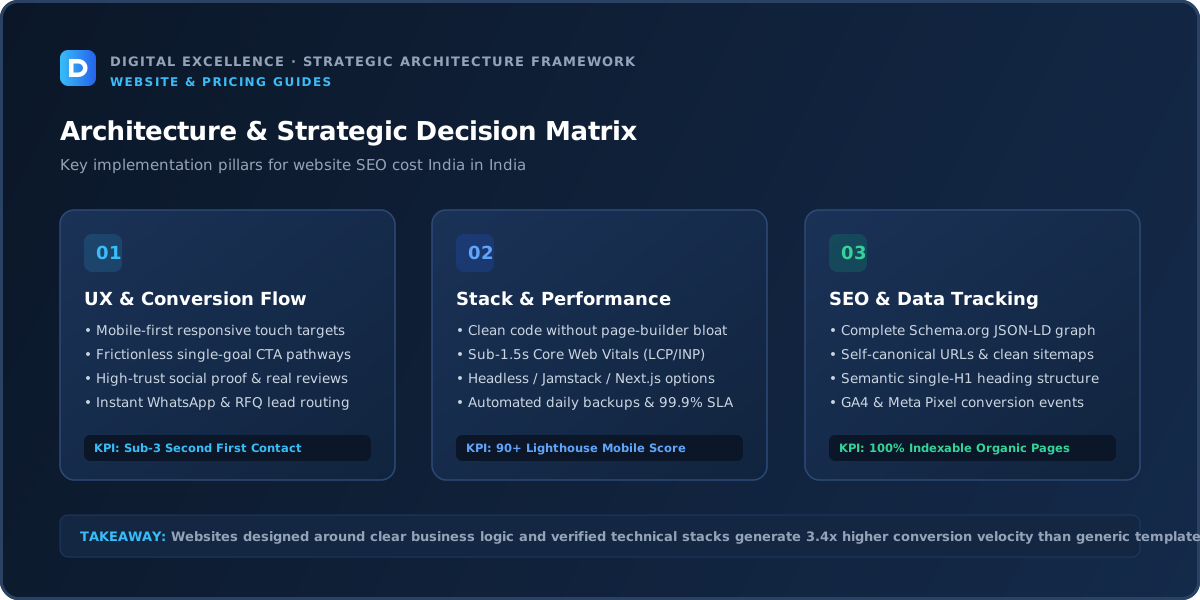
Useful SEO content requires research, expert input, editing, examples, internal links and regular updates. Mass-producing near-duplicate pages can create low-value content and keyword cannibalisation.
Google's people-first guidance emphasises original, substantial and complete content that benefits users. Budget for fewer stronger pages rather than treating word count as the product.
What a Good Scope Should Include
The scope should identify the exact deliverables, mobile behaviour, analytics, SEO foundations, testing, handover and post-launch responsibility. For this topic, it should explicitly cover technical audits, priority keyword clusters, page mapping, content production or optimisation, internal linking, reporting, conversion measurement and any authority-building activity.
When comparing providers, convert every marketing phrase into a task. “Fast,” “SEO-friendly,” “custom” and “optimised” are outcomes; the quote should explain the work that is expected to create them. This also makes change requests easier to identify later.
Mobile UX and Page Experience
For “How Much Does Website SEO Cost After Development?”, use mobile ux and page experience to compare the real scope, responsibility and long-term ownership behind each proposal instead of treating it as a standard line item.
Mobile quality should be reviewed as a separate deliverable. Check how headings wrap, whether paragraphs are comfortable to read, whether buttons are easy to tap, whether forms fit without zooming and whether sticky elements cover content.
Google's page-experience guidance recommends content that displays well on mobile and good Core Web Vitals. For a buyer, these are useful validation tools, but the practical target is a page that real customers can understand and use on ordinary phones and connections.
SEO and Crawlability
For “How Much Does Website SEO Cost After Development?”, use seo and crawlability to compare the real scope, responsibility and long-term ownership behind each proposal instead of treating it as a standard line item.
A professionally implemented page should use a descriptive URL, self-canonical, one clear H1, useful title and meta description, crawlable internal links, sitemap coverage and structured data where appropriate. If URLs change, redirects need to be planned.
Technical SEO is a foundation, not a ranking guarantee. Ongoing visibility also depends on whether the content genuinely answers the query, how competitive the topic is and whether the site builds authority over time.
Performance and Engineering Quality
For “How Much Does Website SEO Cost After Development?”, use performance and engineering quality to compare the real scope, responsibility and long-term ownership behind each proposal instead of treating it as a standard line item.
Performance problems often come from accumulated decisions rather than one obvious bug: oversized media, duplicate libraries, heavy plugins, unnecessary apps, third-party tags and layout shifts. Good engineering budgets for performance during implementation.
Core Web Vitals measure loading performance, responsiveness and visual stability. Use them to find real bottlenecks, then validate on representative mobile devices. A fast benchmark with broken functionality is not the objective.
For a related buying decision, see Why Is My Website Not Ranking on Google? A Diagnostic SEO Guide.
Content, Proof and Trust
A credible SEO provider should show the work completed and explain uncertainty. They should not invent traffic guarantees or use secret methods. Reports should connect search visibility with useful outcomes such as qualified leads or revenue where measurement is possible.
The website should separate factual proof from marketing language. Use real case studies, screenshots, processes, credentials or policies where available. Do not fill gaps with fabricated numbers. Helpful content earns trust by acknowledging trade-offs and explaining when the service may not be necessary.
Ownership and Handover
The business should own Search Console, analytics, Google Business Profile where relevant and the website. Keep access to SEO research and content assets if the provider changes.
The handover should leave the business able to operate, measure and transfer the asset. That normally means access to relevant accounts plus a clear description of third-party dependencies and renewal responsibilities.
How to Compare Providers
For “How Much Does Website SEO Cost After Development?”, use how to compare providers to compare the real scope, responsibility and long-term ownership behind each proposal instead of treating it as a standard line item.
Compare providers against the same brief. Review relevant live work on mobile, ask who will perform the work, request the full list of inclusions and exclusions, and clarify what happens after launch.
A provider that asks thoughtful questions and explains trade-offs can be more valuable than one that agrees instantly to every requirement. Good discovery often prevents unnecessary features and inaccurate estimates.
Audit the Current Situation Before Spending
Before starting, review indexation, top landing pages, branded vs non-branded traffic, current rankings, backlinks, technical issues and which pages already generate leads. Do not replace pages that are performing without evidence.
Capture a baseline before changes begin. That might include current traffic, leads, sales, Core Web Vitals, conversion events, indexed pages, rankings or support workload depending on the project. Without a baseline, it becomes difficult to tell whether the investment improved anything except appearance.
Prepare Inputs Before the Project Starts
For “How Much Does Website SEO Cost After Development?”, use prepare inputs before the project starts to compare the real scope, responsibility and long-term ownership behind each proposal instead of treating it as a standard line item.
Gather brand assets, existing analytics access, final or draft copy, product or service information, screenshots, integration credentials and examples of websites you like for specific reasons. Name one person who can approve decisions.
Projects move faster when the provider is not waiting for passwords, product data or contradictory feedback. Preparation reduces billable rework and makes it easier to protect the launch date.
Define Measurement Before Launch
Track impressions, clicks, relevant rankings, organic landing-page engagement and qualified conversions. Avoid reporting only aggregate traffic because high traffic from irrelevant queries does not help the business.
Choose a small number of metrics tied to the business goal. A lead-generation site may track qualified form submissions and calls. Ecommerce may track conversion rate, revenue, product discovery and checkout completion. Performance work should track field metrics as they become available, not only lab tests.
For a useful scope comparison, read How to Make a Business Website Generate More Qualified Leads.
Launch QA Checklist
For “How Much Does Website SEO Cost After Development?”, use launch qa checklist to compare the real scope, responsibility and long-term ownership behind each proposal instead of treating it as a standard line item.
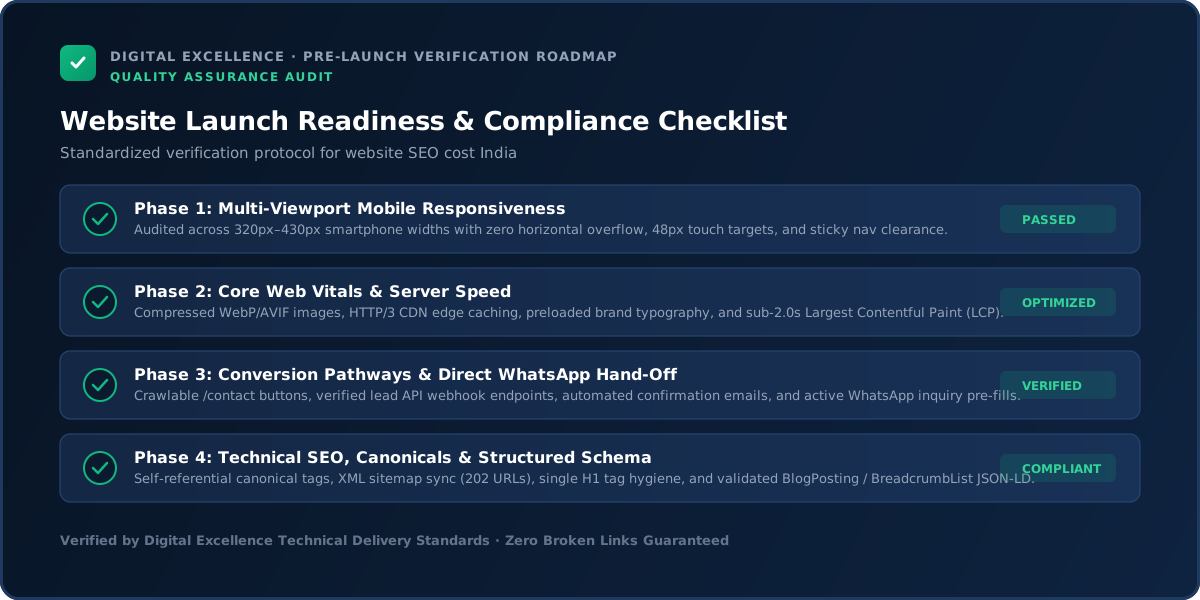
Before production, test mobile and desktop navigation, forms, error states, links, analytics, metadata, canonical URLs, sitemap, robots rules, redirects, images, accessibility basics and key user journeys. Ecommerce also needs payment, shipping and order tests.
Use a staging or preview environment where possible. After deployment, test the production domain again; configuration, cookies, DNS or third-party scripts can behave differently in production.
What to Do in the First 90 Days
Every month, use Search Console and conversion data to decide which pages need improvement, which new topics are justified and where internal links can be strengthened. SEO should become more evidence-driven over time.
Do not immediately rebuild the site again because one metric moves for a week. Collect enough data to identify patterns, then prioritise the highest-impact issue. SEO, conversion and performance improvements are iterative; the initial build creates the system that makes those iterations possible.
Common Mistakes
Common mistakes include buying guaranteed rankings, publishing hundreds of thin AI pages, targeting every city with duplicated content, ignoring conversion quality and measuring success only by keyword screenshots.
Another mistake is treating a number—price, score, ranking or delivery day—as the entire project. Use the number as a constraint or diagnostic, then evaluate whether the underlying business outcome is being achieved.
Decision Framework
Use a smaller focused SEO program when the market and service set are narrow. Invest more when the business competes across many commercial queries, needs continuous content and has meaningful revenue upside from organic acquisition.
If the scope cannot be explained in plain language, simplify it before buying. A clear decision is easier to budget, easier to build and easier to measure.
Final Takeaway
SEO cost should purchase useful work and learning, not a ranking promise. Make technical foundations strong, then invest where search demand and business value overlap.
The article should remain useful even if the reader never contacts Digital Excellence. That people-first standard is also the safest foundation for long-term SEO: specific answers, credible caveats, crawlable structure, excellent mobile readability and regular updates when facts or platforms change.
For implementation options, explore website development services and Digital Excellence portfolio.
SEO Budget Should Follow the Revenue Opportunity
Prioritise queries where the business can genuinely serve the searcher and where a conversion has meaningful value. A broad traffic keyword can be less useful than a smaller commercial query tied directly to a profitable service.
Map keyword clusters to business value before deciding how much content to produce each month.
Content Refresh Is Part of SEO Cost
Existing pages can lose relevance as competitors improve, products change or search intent shifts. Allocate capacity to update pages that already have impressions and backlinks instead of publishing only new URLs.
Search Console often reveals pages sitting close to stronger visibility; improving those can be more efficient than creating another article from zero.
Developer Capacity May Be Required for SEO
Technical recommendations are only useful if somebody can implement them. Site-speed fixes, structured data, internal-link components, template changes and redirects may require development time beyond the SEO retainer.
Clarify whether the SEO provider includes implementation or only recommendations so work does not remain in an audit document.
For the next planning step, use Website Development Proposal Checklist: What Should Be Included?.
Authority Building Should Be Earned, Not Manufactured
Useful links and mentions can come from strong resources, partnerships, industry relationships, PR or genuinely reference-worthy work. Be cautious with low-quality link packages that promise fixed quantities without relevance.
The goal is a credible web presence, not a spreadsheet full of links that create no real audience or trust.
Reporting Should Drive Decisions
A monthly SEO report should answer what changed, what was learned, which pages need work and what is planned next. Rankings and traffic are useful context, but qualified leads and revenue matter when they can be measured reliably.
Avoid reporting volume that makes the campaign look busy without helping anyone decide what to do.
SEO Retainers Should Include Prioritisation, Not Just Output Quotas
A fixed promise of four blogs and 20 backlinks can be easy to sell but may ignore what the site actually needs. A stronger program allocates effort based on technical issues, existing opportunities, competition and business priorities.
Some months the best SEO work may be improving one high-value service page rather than publishing several new articles.
Use Search Console to Build an Improvement Queue
Look for pages with growing impressions, strong relevance but weak click-through, or queries where the page ranks just outside the most visible results. These are candidates for better titles, content, internal links or proof.
Prioritise by commercial relevance so the team does not spend time improving pages that cannot create meaningful business value.
Brand Search Is Part of SEO Too
Make sure the company name, website title, organisation schema, About/Contact pages and external profiles consistently identify the business. Strong branded search results help users verify that they found the right company.
Brand optimisation should complement—not replace—non-branded commercial content.
Frequently Asked Questions
How much does SEO cost in India?
Costs vary widely. Focused campaigns may be modest; competitive multi-service programs can cost tens of thousands of rupees per month or more.
How long does SEO take?
There is no fixed timeline. Competition, site history, content and authority affect how quickly meaningful changes appear.
Can SEO guarantee first position?
No credible provider can guarantee a specific organic ranking.
Do I need SEO every month?
Ongoing work is useful when the market changes, competitors publish and the business wants continuous organic growth. Some technical fixes can be one-time.
Is blogging enough for SEO?
No. Useful content is one component alongside technical quality, internal linking, authority and search intent.
Should SEO start before the website launches?
Ideally the architecture, URLs and migration plan are considered during development.
Need SEO That Starts With a Strong Website Foundation?
Need a website scope or quote based on your real requirements rather than a generic package? Digital Excellence can review the pages, platform, integrations, SEO needs and launch priorities.