How to Make a Business Website Generate More Leads

More leads do not come from adding a contact form to every page. A business website generates demand when the right audience discovers it, understands a specific service, sees enough proof and can take a low-friction next step. The most useful strategy therefore combines acquisition, content architecture, conversion UX and sales follow-up. This guide shows how to improve the complete lead-generation system.
Table of Contents
- Start With the Leads the Business Actually Wants
- Build Commercial Pages Before Publishing Hundreds of Blogs
- Use Industry Relevance Where It Is Real
- Traffic Quality and Intent
- Mobile Experience
- Technical Reliability and Performance
- Trust and Proof
- CTA and Conversion Path
- Analytics and Attribution
- SEO and Internal Linking
- Build a Content Funnel, Not a Blog Library
- What to Fix First
- 30-Day Recovery Plan
- When a Full Redesign Makes Sense
- Final Takeaway
- Map Buyer-Intent Search Topics to Service Pages
- Create Industry Pages Only Where You Have Real Relevance
- Use Case Studies to Convert Research Into Confidence
- Use Cost and Hiring Content for Bottom-of-Funnel Search
- Improve Service Pages With Questions From Leads
- Make Lead Forms Specific to the Service Context
- Measure Qualified Leads by Landing Page
- Use Search Console to Expand Proven Clusters
- Build Internal Links During Publishing, Not Months Later
- Final Lead-Generation Principle
- Build Content Clusters Around Revenue-Critical Services
- Use Problem-Aware Content to Reach Buyers Earlier
- Use Bottom-of-Funnel CTAs Selectively
- Create Portfolio Proof by Industry
- Refresh Content Based on Search Console
- Avoid Publishing All 100 Articles as Near-Duplicates
- Use a Publishing Cadence the Site Can Maintain
- Create a Content QA Checklist
- Final Content-to-Lead Principle
- Build a Publishing Priority Score
- Give Every Article a Clear Primary Keyword and One Primary Intent
- Create an Internal Link Requirement Before Publish
- Use Editorial Images to Add Understanding
- Add Update Ownership
- Closing Principle
- Create a Canonical Keyword Map Before Scaling Beyond 100 Blogs
- Use Search Intent to Choose Blog vs Service Page
- Build Content Around Real Expertise
- Create a Quarterly Pruning and Consolidation Review
- Closing Implementation Rule
- Create a Content Refresh Queue
- Use Author and Publisher Consistently
- Do Not Let 100 Blogs Slow the Website
- Final Lead-Generation Check
- Closing SEO Note
- Final Implementation Note
- Closing Principle
- Frequently Asked Questions
Diagnostic Framework
| Growth lever | Example |
|---|---|
| Commercial SEO | service/cost/comparison pages |
| Problem content | diagnose buyer pain |
| Industry content | niche relevance |
| Proof | case studies/portfolio |
| Conversion | CTA/forms/booking |
| Tracking | source → qualified lead |
| Follow-up | fast, consistent sales process |
Start With the Leads the Business Actually Wants
Define ideal customer, service fit, geography, budget or project characteristics that make an enquiry useful. More raw form submissions can increase sales workload without increasing revenue.
Use this definition to choose keywords, landing pages and form fields.
Build Commercial Pages Before Publishing Hundreds of Blogs
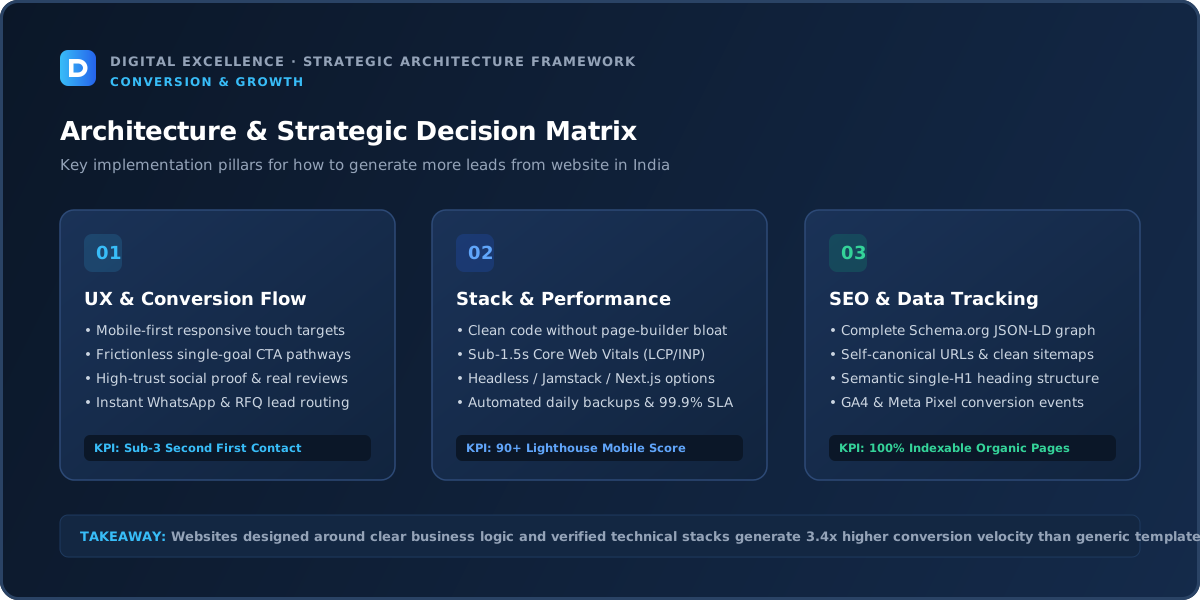
The site needs strong service pages, portfolio/case studies and contact paths before supporting content sends traffic to it. Each high-value service should have enough useful information to satisfy commercial intent.
Blogs can then answer cost, comparison and problem-aware queries that naturally connect to those pages.
Use Industry Relevance Where It Is Real
A clothing brand and a real-estate company have different website needs. Industry-specific pages can be useful when they contain genuine expertise, relevant portfolio proof and different buyer questions.
Avoid copying the same page and replacing only the industry name.
Traffic Quality and Intent
Prioritise channels where the audience can actually become a client. SEO, referrals, paid search, social and partnerships can all work, but each needs a suitable landing experience.
Mobile Experience
For “How to Make a Business Website Generate More Leads”, interpret mobile experience through the specific business goal and audience of the page so the recommendation stays practical rather than becoming a generic checklist.
Review the primary journey at common phone widths. Check content priority, forms, sticky elements, buttons, page weight and whether key information is buried below decorative sections. Compare mobile and desktop within the same acquisition source when possible.
The mobile version should be intentionally designed rather than a compressed desktop layout.
Technical Reliability and Performance
For “How to Make a Business Website Generate More Leads”, interpret technical reliability and performance through the specific business goal and audience of the page so the recommendation stays practical rather than becoming a generic checklist.
Test forms, checkout, booking, call/WhatsApp links, analytics events and error states. Use Core Web Vitals and real-device testing to catch loading, responsiveness and layout-stability problems.
Technical reliability comes before optimisation experiments. If the primary action fails intermittently, no amount of copy testing will produce clean data.
Trust and Proof
Lead generation for high-value services depends heavily on proof. Show relevant projects, process, qualifications or specific experience without fabricating results.
CTA and Conversion Path
Offer an action appropriate to the buying stage: consultation, project quote, audit or call. Explain what happens after submission.
Analytics and Attribution
Track qualified leads and source/landing page, not only sessions. Where possible, connect leads to sales outcomes so marketing can prioritise channels that produce revenue.
SEO and Internal Linking
For “How to Make a Business Website Generate More Leads”, interpret seo and internal linking through the specific business goal and audience of the page so the recommendation stays practical rather than becoming a generic checklist.
Search traffic should be analysed by query and landing page. A rise in informational traffic can be valuable without producing immediate revenue, but the site should offer contextual routes to relevant commercial content.
Use crawlable contextual internal links. Avoid publishing near-duplicate pages solely to capture keyword variants; each indexable page should have a distinct useful purpose.
Build a Content Funnel, Not a Blog Library
Organise content into clusters around services: cost guides, comparisons, hiring guides, problem-solving articles and industry-specific resources. Link these pages contextually to the relevant service and case studies.
This creates a useful journey for users and a clearer site structure for search engines. Quality and distinct intent matter more than the number of URLs.
For a related diagnosis, see Website Getting Traffic but No Leads? Diagnose These 12 Problems.
What to Fix First
For “How to Make a Business Website Generate More Leads”, interpret what to fix first through the specific business goal and audience of the page so the recommendation stays practical rather than becoming a generic checklist.
Prioritise broken functionality, wrong traffic, offer mismatch, trust gaps, mobile friction and conversion-path issues before small visual experiments. Write one hypothesis for each meaningful change and record the deployment date.
This keeps optimisation connected to evidence rather than opinion.
30-Day Recovery Plan
For “How to Make a Business Website Generate More Leads”, interpret 30-day recovery plan through the specific business goal and audience of the page so the recommendation stays practical rather than becoming a generic checklist.
Week one: validate tracking and establish baseline. Week two: fix the highest-confidence content, trust and mobile issues. Week three: improve conversion steps and high-intent landing pages. Week four: compare results and decide which issue deserves the next iteration.
Do not interpret tiny samples as proof. Combine quantitative data with customer questions and sales feedback.
When a Full Redesign Makes Sense
For “How to Make a Business Website Generate More Leads”, interpret when a full redesign makes sense through the specific business goal and audience of the page so the recommendation stays practical rather than becoming a generic checklist.
Redesign when the existing architecture, CMS, design system or technology prevents repeated improvement. If the problem is one channel, one page or one broken flow, fix that directly first.
If redesigning, preserve useful URLs, content and analytics context so the new design does not reset assets that were already working.
Final Takeaway
More website leads come from relevance and trust, not just traffic volume. Build strong commercial destinations, then attract and guide the right audience into them.
Map Buyer-Intent Search Topics to Service Pages
Build strong commercial pages first, then supporting articles around cost, comparisons, hiring, problems and industries. Each cluster should have a clear service destination.
This creates a useful path from early research to a sales conversation without creating hundreds of isolated blog posts.
Create Industry Pages Only Where You Have Real Relevance
Industry-specific content should discuss actual needs and show relevant work when available. Do not duplicate the same page and replace ‘restaurant’ with ‘real estate.’
Distinct content is easier to trust and less likely to compete with itself.
Use Case Studies to Convert Research Into Confidence
When a visitor reads an article about a problem, link to a relevant project that shows how the business approaches similar work. Explain the context and work delivered.
Case studies should support the claim with real details, not invented results.
Use Cost and Hiring Content for Bottom-of-Funnel Search
People comparing prices, agencies or developer types are often closer to a decision than people reading basic definitions. Build detailed guides that help them compare options honestly.
Use a relevant consultation CTA after the article has answered the question.
Improve Service Pages With Questions From Leads
Sales conversations reveal what buyers need before they commit: timeline, platform, maintenance, ownership, price drivers or process. Add recurring answers to the service page.
This improves both qualification and conversion.
Make Lead Forms Specific to the Service Context
Carry the current service or industry into the form automatically where possible. Ask only the qualification questions the sales team uses.
Generic forms create extra work for the visitor and the salesperson.
Measure Qualified Leads by Landing Page
A blog may drive fewer enquiries than a service page but still influence future demand. Track direct leads, assisted paths where useful and sales quality.
Do not optimise content solely for raw traffic.
Use Search Console to Expand Proven Clusters
When a page gains impressions for relevant questions, update it or create supporting content where the intent is genuinely distinct. Let real query data guide expansion.
Avoid producing hundreds of speculative articles at once.
For another useful funnel check, read Business Website Not Generating Enquiries? Fix These Problems.
Build Internal Links During Publishing, Not Months Later
Every new article should identify related service, supporting guides and case studies before launch. This keeps the site architecture coherent as content volume grows.
Final Lead-Generation Principle
A website creates sustainable leads when useful search content feeds strong commercial pages, proof reduces risk, mobile UX removes friction and sales receives the enquiry reliably.
Build Content Clusters Around Revenue-Critical Services
For each service, create a hub of buyer questions: cost, timeline, alternatives, hiring, problems, industry applications and case studies. Internal links should connect the cluster rather than leaving 50 unrelated articles.
This creates depth without forcing every keyword into one page.
Use Problem-Aware Content to Reach Buyers Earlier
Articles such as ‘Why is my website not generating sales?’ can attract businesses that have not decided they need a developer yet. Solve the problem honestly, then show when development or redesign is a relevant next step.
This creates demand without turning the article into a disguised ad.
Use Bottom-of-Funnel CTAs Selectively
Cost, hiring and comparison articles can use stronger consultation CTAs because the reader is closer to a provider decision. Educational guides may use softer next steps.
Match the CTA to search intent rather than pasting the same banner on every page.
Create Portfolio Proof by Industry
When targeting clothing, jewellery, beauty, real estate or other niches, connect the article to genuinely relevant portfolio examples. If no relevant proof exists yet, do not invent it.
The content can still demonstrate expertise through specific buyer guidance.
Refresh Content Based on Search Console
Pages with impressions but weak click-through can benefit from better titles or alignment. Pages ranking for unexpected queries can reveal new sections or supporting topics.
Use real data to guide expansion after the first publishing batch.
Avoid Publishing All 100 Articles as Near-Duplicates
High content volume is useful only when each page has a distinct search intent and substantial unique value. Merge overlapping ideas and differentiate industry content with real category-specific detail.
Google's people-first guidance supports usefulness over volume.
Use a Publishing Cadence the Site Can Maintain
Publishing 100 pages at once is technically possible, but a staged rollout makes QA, indexing and performance easier to monitor. Prioritise buyer-intent clusters, then expand from results.
The content can be prepared in advance while publication remains controlled.
Create a Content QA Checklist
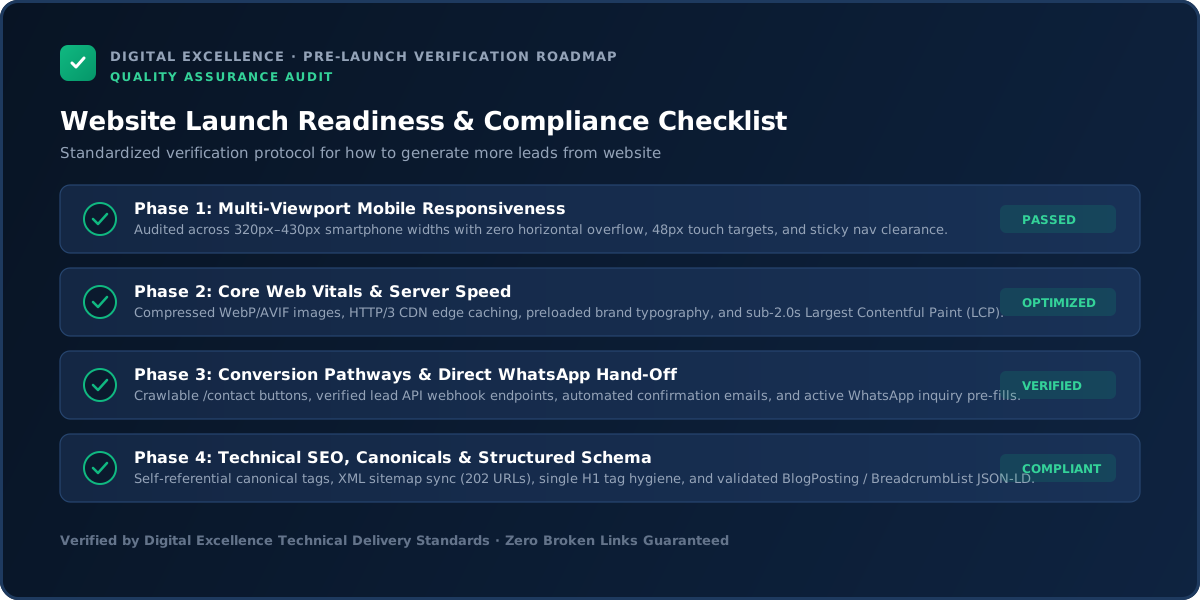
Before publishing, verify title/meta, one H1, canonical, TOC, mobile readability, internal links, images/alt text, schema, author/publisher, sitemap and CTA. Confirm there are no unsupported facts or broken routes.
Final Content-to-Lead Principle
SEO content should answer the query better than a sales page would, then make the relevant commercial next step easy to discover. Help first; convert through relevance and trust.
Build a Publishing Priority Score
Score topics by buyer intent, relevance to profitable services, search opportunity, proof available and internal-link fit. Publish the highest-value clusters first.
This is more useful than publishing in the order ideas were generated.
Give Every Article a Clear Primary Keyword and One Primary Intent
Secondary terms can be used naturally, but the article should not try to rank for five different commercial intents. Clear ownership reduces cannibalisation.
For the next troubleshooting step, use Turn Website Visitors Into Paying Customers.
Create an Internal Link Requirement Before Publish
Each article should link to at least one relevant commercial page and a small number of useful supporting articles where they exist. Service pages should also link back to strong supporting guides when helpful.
Use Editorial Images to Add Understanding
Screenshots, diagrams, process visuals or comparison graphics can make long articles easier to scan. Avoid generic stock images that add no information.
Compress media and give it descriptive alt text.
Add Update Ownership
Record who reviews pricing, platform features and time-sensitive facts. A large blog library becomes an SEO liability if old information remains untouched for years.
Closing Principle
The strongest 100-blog strategy behaves like a connected knowledge base around real services, not 100 isolated keyword pages.
Create a Canonical Keyword Map Before Scaling Beyond 100 Blogs
Keep one sheet with primary topic, preferred URL, intent, parent service, supporting pages and publish/update status. This reduces accidental duplication as the library grows.
When a new idea overlaps heavily, improve the existing page instead of creating another URL.
Use Search Intent to Choose Blog vs Service Page
Queries such as ‘website development company in Mumbai’ are primarily provider-seeking and often deserve commercial landing pages, while ‘why is my website slow’ suits a problem-solving guide.
Do not force every keyword into the blog template.
Build Content Around Real Expertise
Add project screenshots, implementation lessons, founder commentary or process detail that competitors cannot copy from generic search summaries. Original experience is one of the best ways to make AI-assisted content less interchangeable.
Create a Quarterly Pruning and Consolidation Review
As the library grows, identify pages with overlapping intent, no impressions or outdated information. Merge where one stronger resource would serve users better.
Scaling content also requires scaling maintenance.
Closing Implementation Rule
Publish enough content to cover the market deeply, but let data decide where the next 100 pages come from. Volume should follow demonstrated relevance.
Create a Content Refresh Queue
Track publication date, last review, impressions, clicks, conversions and notes for every important article. Prioritise updates where facts changed or the page already shows relevant search demand.
Use Author and Publisher Consistently
Publish under a genuine author where appropriate and keep Digital Excellence's organisation details consistent. Schema should reflect visible page information rather than adding hidden authority claims.
Do Not Let 100 Blogs Slow the Website
Use static or efficient rendering, optimised images, pagination and a clean sitemap. Large content libraries should remain fast to crawl and fast to read on mobile.
Final Lead-Generation Check
For every blog, identify the user problem solved, the commercial service it supports and the next useful page. If those relationships are unclear, revisit the topic before publishing.
Closing SEO Note
The content moat comes from depth, organisation, evidence and maintenance—not merely having more URLs than competitors.
Final Implementation Note
Maintain the keyword map, internal-link graph and refresh queue as living SEO assets. As Search Console data grows, improve proven pages and merge overlapping ones before expanding the library further.
Closing Principle
Publish for usefulness first, then use technical SEO and internal linking to make that usefulness discoverable.
For implementation options, explore website development services and Digital Excellence portfolio.
Frequently Asked Questions
What type of content generates leads?
Commercial cost, comparison, problem and industry content can attract buyers when it genuinely answers their questions.
How many service pages do I need?
Create pages for meaningful distinct services and intents, not arbitrary SEO volume.
Should I put a CTA in every blog?
Use a relevant next step where it helps the reader; avoid aggressive unrelated sales prompts.
How do I improve lead quality?
Target clearer intent, explain fit and use only useful qualification fields.
Do case studies help?
Relevant genuine case studies can reduce risk and demonstrate capability.
How long does lead-generation SEO take?
There is no guaranteed timeline; competition, site authority and content quality matter.
Want a Website Designed to Generate Qualified Leads?
Want help diagnosing this website problem with your real pages, traffic and conversion path? Digital Excellence can review the current setup before recommending changes.