Custom Web Application Development Cost in India
Custom web applications are priced differently from normal websites because the team is not only publishing pages. It may be modelling data, creating user accounts, permissions, dashboards, workflows, APIs and operational tools. That is why a five-screen application can cost more than a 100-page marketing website. The budget follows business logic and risk. This guide explains custom web application development cost in India and how to plan an MVP without paying for unnecessary architecture.
Table of Contents
- Why Web Apps Cost More Than Marketing Websites
- MVP Scope Is the Biggest Cost Lever
- Backend, Data and Integrations
- What a Professional Scope Should Include
- Mobile Readability and User Experience
- SEO Foundations and Search Intent
- Performance and Technical Quality
- Hidden and Recurring Costs
- Ownership and Handover
- How to Compare Quotes
- Common Mistakes to Avoid
- A Practical Decision Framework
- Pre-Purchase Checklist
- Final Takeaway
- Discovery Is Part of Custom Application Development
- Authentication and Permissions Add More Complexity Than They Appear To
- Admin Panels Are Product Features Too
- Budget for Error States, Not Just the Happy Path
- Testing and Environments
- Plan for Maintenance Before Launch
- A Better Way to Reduce Custom App Cost
- Data Migration Can Become Its Own Project
- Security Requirements Should Match the Data and Risk
- Observability Makes Post-Launch Support Cheaper
- Product Analytics Should Answer Behaviour Questions
- Architecture Should Be Revisited When Evidence Changes
- Commercial Terms for Custom Software Need Extra Clarity
- Custom App Budgets Should Include Product Decisions
- Frequently Asked Questions
Custom Web App Planning Bands
| Build | Broad range | Typical complexity |
|---|---|---|
| Prototype / lean MVP | ₹1.5L–₹4L | one core workflow, limited roles |
| Production MVP | ₹3L–₹8L | auth, database, admin, integrations |
| Complex portal/SaaS | ₹6L–₹15L+ | multiple roles, workflows, reporting |
| Large custom platform | ₹10L+ | advanced integrations, scale, governance |
Why Web Apps Cost More Than Marketing Websites
A web application stores and changes data based on user actions. The team may need to design database relationships, permissions, validation, error states and background processes that visitors never see. Those invisible systems are often where reliability is created.
Custom applications also need environments, deployment, monitoring and security practices. Visual screen count is therefore a poor estimator.
MVP Scope Is the Biggest Cost Lever
An MVP should test the core workflow with the minimum reliable feature set. Founders often turn an MVP into a full product by adding advanced reporting, automation, multiple roles and edge-case workflows before the first users arrive.
Define the hypothesis the MVP must test and move secondary features into a backlog. Reducing scope is usually more effective than negotiating developer rates.
Backend, Data and Integrations
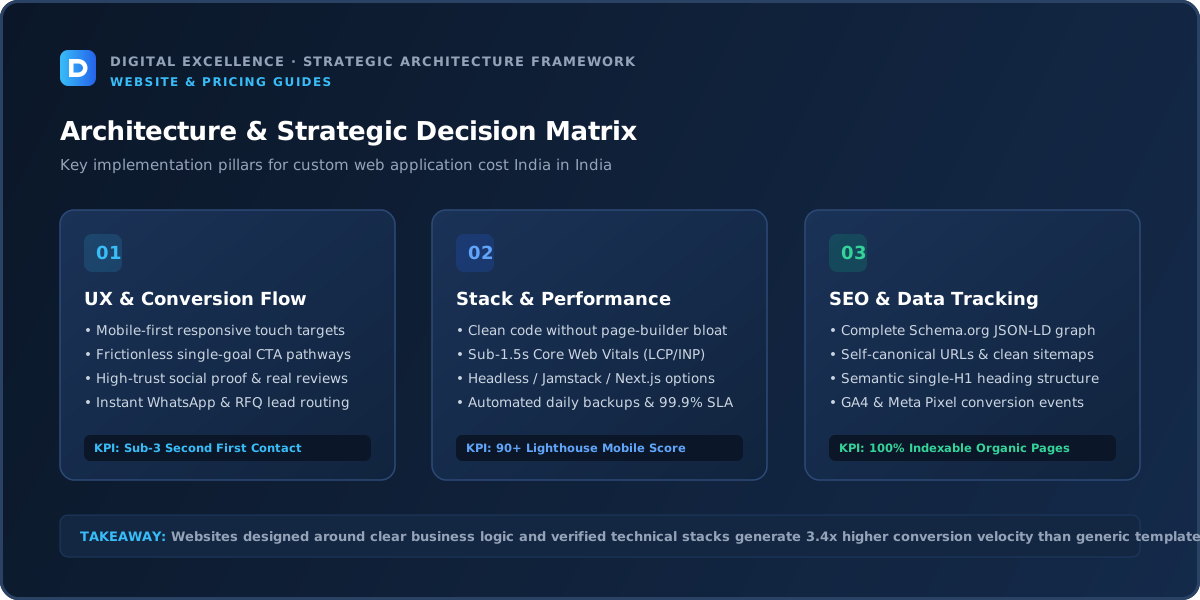
Authentication, databases, payments, file storage, email, search, external APIs and permissions can each create engineering and testing work. Integrations also introduce dependencies on systems the development team does not control.
List every external service before estimating. One “simple CRM integration” can mean a form webhook or a two-way synchronisation layer; those are very different tasks.
What a Professional Scope Should Include
A clear scope should identify the deliverable, mobile behaviour, content responsibilities, integrations, analytics, SEO foundations, testing and post-launch ownership. For a custom web application, this also means user roles, authentication, database model, admin workflows, APIs, error handling, logs, security, backups and deployment environments.
Avoid proposals that use broad labels without explaining what will actually be done. “Optimised,” “custom,” “secure” and “SEO-ready” should translate into visible tasks and acceptance criteria. A written scope protects both sides because ordinary feedback can be separated from genuinely new requirements.
Mobile Readability and User Experience
When evaluating “custom web application cost India”, this mobile readability and user experience point should be tied to a written deliverable, owner or test so two quotes can be compared on the same basis.
Mobile usability should be planned before launch rather than fixed after complaints arrive. Check navigation, tap targets, heading size, forms, tables, images, sticky CTAs and long-form text at common phone widths. A site can pass a basic responsive check and still be unpleasant to use.
Google recommends an overall good page experience, including mobile-friendly content and good Core Web Vitals. For buyers, the practical question is simpler: can a real customer understand the page quickly and complete the intended action without fighting the interface?
SEO Foundations and Search Intent
The page should have one clear search intent, a descriptive title, logical headings, clean canonical URL, crawlable internal links and sitemap coverage. Structured data such as Article or BreadcrumbList should be added where appropriate.
If a custom web application is being bought specifically to improve search performance, clarify which work is technical setup and which work is ongoing SEO. Development can remove technical barriers, but rankings also depend on content quality, competition, authority and time.
Performance and Technical Quality
When evaluating “custom web application cost India”, this performance and technical quality point should be tied to a written deliverable, owner or test so two quotes can be compared on the same basis.
Image handling, third-party scripts, plugins, apps and animation choices all affect performance. Ask how the provider will control asset size, layout shift and unnecessary JavaScript.
Core Web Vitals are useful diagnostics for loading, responsiveness and visual stability. They should inform the build, but do not buy a project only because a proposal promises a perfect score. Real-world usability and maintainability matter more than one lab screenshot.
For a related buying decision, see Website Development Timeline: Project-by-Project Guide.
Ownership and Handover
The company should control source repositories, cloud accounts, production secrets management and critical third-party services. Documentation and environment setup matter because custom software is harder to transfer than a standard CMS.
Good handover includes the accounts and documentation needed to operate the asset. If another competent developer cannot take over without rebuilding everything, the low initial price may create a high switching cost later.
How to Compare Quotes
When evaluating “custom web application cost India”, this how to compare quotes point should be tied to a written deliverable, owner or test so two quotes can be compared on the same basis.
Create a simple matrix: scope, mobile work, SEO, content, integrations, QA, timeline, revisions, ownership, support and recurring costs. Mark anything that is not specified instead of treating it as included.
Then compare the provider's relevant live work and the quality of their discovery questions. A strong quote explains assumptions and trade-offs; it does not simply attach a price to a page count.
Common Mistakes to Avoid
Common mistakes include overbuilding before user validation, choosing architecture for theoretical scale, ignoring admin workflows, underestimating QA and treating security or backups as post-launch features.
Another common mistake is buying more complexity than the business can operate. A smaller, focused implementation with strong foundations is normally better than an overloaded first version that becomes difficult to maintain.
A Practical Decision Framework
Invest in custom development when unique workflows are core to the product. Use established SaaS or CMS tools for standard capabilities so custom engineering stays focused on what differentiates the business.
Write the decision in plain language: what outcome is required, what features are genuinely necessary, which risks matter and what the business must own after launch. If you cannot explain why a feature is in the scope, consider moving it to a later phase.
Pre-Purchase Checklist
When evaluating “custom web application cost India”, this pre-purchase checklist point should be tied to a written deliverable, owner or test so two quotes can be compared on the same basis.
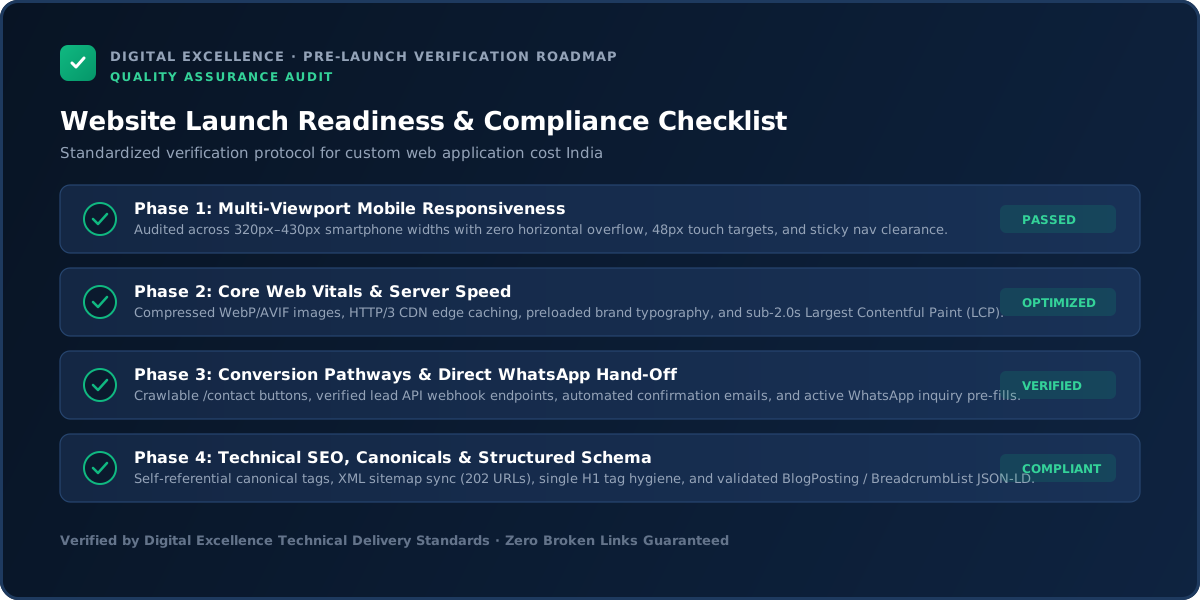
Before approving the project, confirm the primary goal, audience, scope, platform, content owner, mobile requirements, integrations, SEO work, analytics, testing, timeline, payment milestones, recurring costs, access, maintenance and handover.
This checklist is intentionally boring. Most expensive website problems come from boring details that nobody clarified before development began.
Final Takeaway
Custom web application budgeting should follow workflows and risk, not screen count. Keep the first version focused and buy complexity only when users or operations require it.
Publish the article as a decision resource, not a sales page disguised as advice. The strongest long-term SEO value comes from useful specificity, clean internal linking, strong mobile reading experience and periodic updates based on real search and customer questions.
For implementation options, explore website development services and Digital Excellence portfolio.
Discovery Is Part of Custom Application Development
Before estimating a custom app, the team needs to understand users, roles, core workflows, data, edge cases and external systems. A short discovery phase can save substantial engineering time because assumptions are tested before they become code.
Useful outputs include user flows, a prioritised feature list, data model outline, integration requirements and an MVP definition. Discovery should reduce uncertainty, not produce documentation that nobody uses.
For a useful scope comparison, read Website Development Proposal Checklist: What Should Be Included?.
Authentication and Permissions Add More Complexity Than They Appear To
A login screen is simple; a secure permission model is not. Applications may need owners, admins, staff, customers or vendors with different access. Every role creates rules about what can be viewed, edited or exported.
Define these rules early. Retrofitting permissions after features are built can create expensive rework and security risk.
Admin Panels Are Product Features Too
Many teams focus only on the customer-facing interface and underestimate the internal tools required to manage users, orders, content, support or exceptions. If staff need to perform a task regularly, the admin workflow should be part of scope.
A weak admin panel pushes operational work into spreadsheets and manual database changes, which can erase the efficiency the application was supposed to create.
Budget for Error States, Not Just the Happy Path
Production software needs to handle failed payments, invalid data, unavailable APIs, duplicate submissions, expired sessions and network interruptions. These states require design, code and testing.
An MVP can simplify edge cases, but the team should explicitly decide which ones are acceptable to postpone. Ignoring them is different from intentionally deferring them.
Testing and Environments
Use separate development, preview/staging and production environments where practical. Automated tests can protect critical business logic, while manual QA validates real user journeys across devices.
The level of testing should match risk. A simple internal tool does not need the same test strategy as a payment-heavy SaaS platform, but every production app should have a repeatable release process.
Plan for Maintenance Before Launch
Custom software continues to change after the first release. Dependencies receive updates, APIs change and users discover real edge cases. Decide who will monitor errors, deploy fixes and own infrastructure.
A maintenance plan does not need to be a large retainer, but the business should know who is responsible when something breaks.
A Better Way to Reduce Custom App Cost
Reduce the number of workflows, roles and integrations in version one. Reuse reliable managed services for authentication, payments, email or storage when they fit. Keep the custom engineering focused on the business logic that creates unique value.
Negotiating developer rates has a smaller effect than removing speculative scope.
Data Migration Can Become Its Own Project
If the application replaces spreadsheets, an old SaaS tool or a legacy database, migration needs mapping, cleanup, validation and rollback planning. Moving records is rarely just an export/import exercise when fields and business rules differ.
Decide which historical data is truly needed. Migrating everything by default increases cost and can copy years of bad data into the new system.
For the next planning step, use Website Development Contract Checklist for Business Owners.
Security Requirements Should Match the Data and Risk
Applications handling payments, private customer data or business-critical workflows need stronger controls than a simple public tool. Define authentication, access, logging, secrets, backups and vendor dependencies appropriate to the risk.
Do not buy enterprise ceremony for a prototype, but do not postpone obvious security responsibilities simply because the first user count is small.
Observability Makes Post-Launch Support Cheaper
Error tracking, basic logs and uptime monitoring help the team diagnose issues without waiting for users to describe them. For complex apps, application metrics can show where workflows fail or APIs slow down.
Adding sensible observability during development is usually cheaper than debugging a production system with no record of what happened.
Product Analytics Should Answer Behaviour Questions
Track the core activation or workflow events that indicate whether users reach value. Avoid instrumenting hundreds of clicks before the team knows what decisions those events will support.
For an MVP, a small set of reliable events plus direct user feedback is often more useful than a sophisticated dashboard.
Architecture Should Be Revisited When Evidence Changes
The initial stack is a decision under uncertainty. As usage grows, the team may discover different bottlenecks than expected. Build clean boundaries and documentation so parts of the system can evolve without rewriting everything.
Scalability means being able to change responsibly, not predicting every future requirement on day one.
Commercial Terms for Custom Software Need Extra Clarity
Clarify what happens when the MVP reveals that a major workflow must change. Fixed-price software contracts need explicit assumptions and change control; time-and-materials projects need budget checkpoints and priority management.
Also define ownership of custom code, third-party services, infrastructure and data. A custom application is a long-lived business asset, so handover and continuity deserve the same attention as feature delivery.
Custom App Budgets Should Include Product Decisions
A software team cannot remove the need for product decisions. Somebody must decide role permissions, edge cases, notification rules, pricing logic and what happens when a workflow fails. Slow decisions can consume as much budget as difficult engineering.
Assign a product owner with authority to make trade-offs and keep a written decision log for important behaviour. This reduces rework and gives future developers useful context.
Frequently Asked Questions
How much does a custom web app cost in India?
A lean MVP may start in the low lakhs, while complex production platforms can cost ₹10 lakh or more. Scope and business logic dominate pricing.
What makes a web app expensive?
User roles, data models, integrations, payments, automation, reporting, security and QA.
Should I build an MVP first?
Usually yes when the product or workflow is still being validated.
Which tech stack is best?
There is no universal best stack. Choose based on requirements, team capability and long-term maintenance.
What recurring costs should I expect?
Cloud infrastructure, databases, storage, email, monitoring and external APIs are common.
Who should own the source code?
Ownership and license terms should be explicit in the contract, and the business should have repository access where appropriate.
Planning a Custom Web Application or MVP?
Need a website scope or quote based on your real requirements rather than a generic package? Digital Excellence can review the pages, platform, integrations, SEO needs and launch priorities.