B2B Website Development Cost in India

A B2B website often has a harder job than a simple brochure site. It may need to explain a complex service to several decision-makers, establish credibility, show industry relevance and capture enough information for sales to qualify the enquiry. That makes B2B website development cost in India heavily dependent on content architecture, proof and CRM integration. This guide explains what deserves budget and what can remain simple.
Table of Contents
- Understand the Buyer Intent Behind “B2B website development cost India”
- B2B Websites Need to Support a Longer Buying Journey
- What a Professional Deliverable Should Include
- How Design Quality Changes the Outcome
- Mobile Readability Is a Buying Requirement, Not a Bonus
- Technical SEO Foundations to Expect
- Content Architecture and Internal Linking
- Performance and Core Web Vitals
- Ownership, Access and Long-Term Maintainability
- Hidden and Recurring Costs
- How to Compare Providers for This Exact Project
- Common Mistakes Buyers Make
- A Practical Pre-Project Checklist
- How Much Should a B2B Company Spend?
- Final Takeaway
- B2B Pages Should Support More Than One Decision-Maker
- Use Case Studies as Sales Enablement, Not Decoration
- Lead Qualification Should Be Intentional
- Content Should Reflect the Length of the B2B Sale
- CRM Attribution Is Valuable Only When the Data Is Clean
- B2B Website Investment Should Follow Pipeline Value
- B2B Final Rule
- Frequently Asked Questions
B2B Website Planning Bands
| Level | Broad planning band | Typical use |
|---|---|---|
| Basic B2B presence | ₹40,000–₹80,000 | credibility and enquiries |
| Growth lead-gen site | ₹80,000–₹2,50,000 | service/industry pages, proof, SEO |
| Advanced B2B platform | ₹2,50,000–₹6,00,000+ | integrations, resources, custom workflows |
Understand the Buyer Intent Behind “B2B website development cost India”
Someone searching this phrase is usually not looking for a definition of web development. They are trying to make a purchasing decision: what it costs to build a B2B site that explains complex services, creates trust and turns research-stage visitors into qualified enquiries. That means the article should answer practical questions quickly—what a suitable solution looks like, what affects cost or quality, what mistakes to avoid and what evidence to request from a provider.
For Digital Excellence, this kind of query should not be treated as a generic traffic opportunity. The page has to earn trust by being specific. It should explain trade-offs rather than repeating that every business needs a “modern responsive website.” Useful commercial content helps the reader decide even if they do not become a lead immediately.
B2B Websites Need to Support a Longer Buying Journey
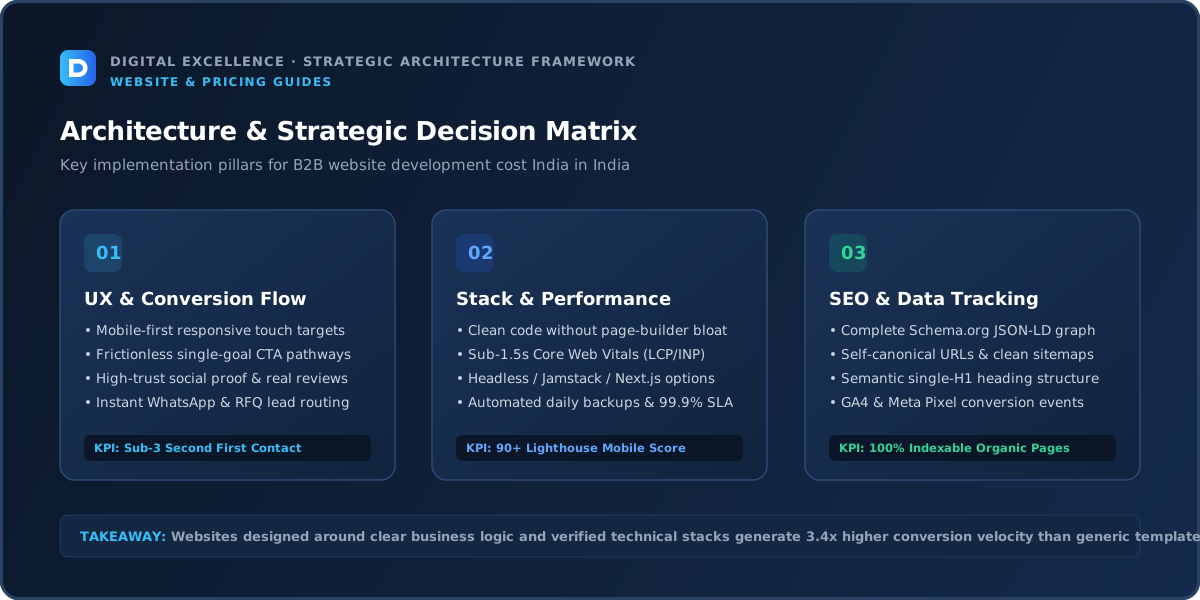
B2B buyers may research capabilities, industries, proof, technical details and case studies before contacting sales. A single generic services page often cannot support that journey.
A strong scope separates launch-critical work from phase-two ideas. That makes pricing more accurate and reduces the risk that a project starts as a straightforward website and slowly turns into a custom application. Ask the provider to write assumptions beside the quote so you can see what happens if the assumptions change.
What a Professional Deliverable Should Include
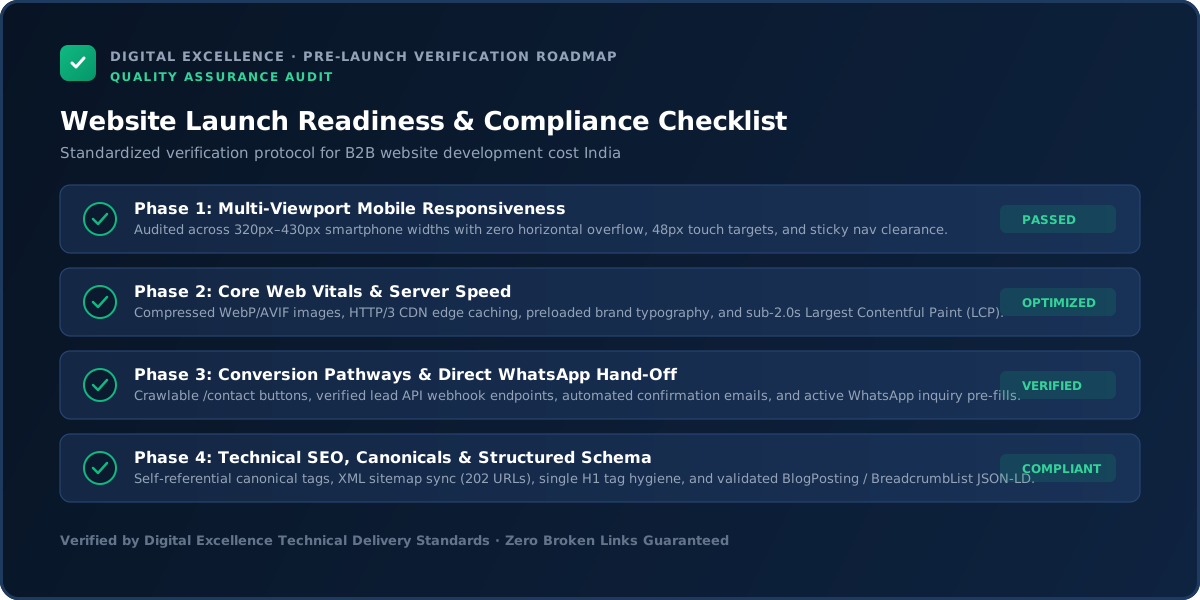
A professional B2B lead-generation website should include deliberate mobile behaviour, clear navigation, accessible content hierarchy, reliable forms, an editing workflow appropriate to the business, analytics, search-engine crawlability and a defined launch process.
Depending on the project, it may also include service and solution pages, industry pages, case studies, technical resources, gated content, qualification forms, CRM routing, analytics and search-focused content architecture. The important point is that these are implementation responsibilities, not marketing labels. “SEO-ready,” “conversion-focused” and “custom” only become meaningful when the proposal explains the work behind them.
Ask to see a deliverables list rather than assuming every expected feature is included.
How Design Quality Changes the Outcome
A practical check for “B2B Website Development Cost in India” is whether how design quality changes the outcome changes cost, risk, timeline or handover. If it does, make that assumption explicit before approving the project.
Design is not only visual styling. It determines how quickly a visitor understands the offer, how much information appears before the first action, whether proof is easy to find and whether mobile content remains readable.
A lower-budget project can still have excellent design when the system is simple and focused. Higher budgets are justified when the brand needs more original components, detailed responsive states, a large design system, complex motion or multiple user journeys.
Do not pay for animation that makes information harder to consume. The strongest design work usually makes the business easier to understand.
Mobile Readability Is a Buying Requirement, Not a Bonus
A practical check for “B2B Website Development Cost in India” is whether mobile readability is a buying requirement, not a bonus changes cost, risk, timeline or handover. If it does, make that assumption explicit before approving the project.
Many potential customers will first experience the website on a phone, especially when traffic comes from social media, search or messaging apps. A site can technically be responsive while still using oversized headings, cramped forms, tiny comparison tables or floating buttons that cover content.
Ask how the provider tests common mobile widths and long-form pages. Check several live portfolio sites yourself. The final build should handle navigation, typography, images, forms, sticky elements and tables deliberately.
Google also recommends an overall good page experience, including content that displays well on mobile and good Core Web Vitals. Those are useful quality checks, not substitutes for a genuinely usable page.
Technical SEO Foundations to Expect
A practical check for “B2B Website Development Cost in India” is whether technical seo foundations to expect changes cost, risk, timeline or handover. If it does, make that assumption explicit before approving the project.
The build should make it easy for search engines to crawl and understand important pages. That normally means sensible URLs, one clear H1, descriptive titles and meta descriptions, canonical tags, sitemap coverage, robots configuration, crawlable internal links and structured data where appropriate.
If the project replaces an existing site, redirects and migration planning become important. If the goal is long-term organic acquisition, someone also needs to map search intent to dedicated service or industry pages.
Technical SEO does not guarantee rankings. It prevents avoidable technical mistakes and gives useful content a cleaner foundation.
For a related buying decision, see Web Development Agency Cost in India.
Content Architecture and Internal Linking
A practical check for “B2B Website Development Cost in India” is whether content architecture and internal linking changes cost, risk, timeline or handover. If it does, make that assumption explicit before approving the project.
A buyer-focused website should not force every service into one long homepage. Important services, industries or product categories may deserve their own pages when the content can genuinely satisfy a distinct search and customer need.
Google recommends contextual, crawlable internal links to help people and search engines understand related pages. In practice, that means a relevant article can link to a service page, case study and related guide using descriptive anchor text.
The objective is not to create hundreds of thin pages. It is to build a small number of strong topic clusters where each page has a clear job.
Performance and Core Web Vitals
A practical check for “B2B Website Development Cost in India” is whether performance and core web vitals changes cost, risk, timeline or handover. If it does, make that assumption explicit before approving the project.
Performance depends on design and engineering choices: image size, font loading, script weight, animations, apps, plugins and third-party tracking. A provider who plans these early can avoid a costly optimisation sprint after launch.
Core Web Vitals measure loading performance, responsiveness and visual stability. They are useful diagnostics, but the buyer should care about the human outcome: does meaningful content appear quickly, does the page respond when tapped, and does the layout stay stable?
Ask how the build will control images and scripts and how performance is checked before production.
Ownership, Access and Long-Term Maintainability
The company should control the domain, analytics, CRM integrations, CMS and source or deployment access. Marketing should be able to update core content without rebuilding pages from scratch.
For custom code, repository access and deployment ownership should be explicit. For WordPress, clarify hosting and premium-plugin licenses. For Shopify, the merchant should control the store and key apps.
A professional build should make future changes possible without starting from zero. Documentation, reusable components and clean ownership often create more long-term value than one extra launch-day effect.
How to Compare Providers for This Exact Project
A practical check for “B2B Website Development Cost in India” is whether how to compare providers for this exact project changes cost, risk, timeline or handover. If it does, make that assumption explicit before approving the project.
Shortlist providers with relevant live work, then compare the same criteria: understanding of the business, recommended platform, written scope, mobile quality, SEO foundations, integrations, QA, ownership, support and total cost.
Ask what they would simplify in your brief. Strong providers often save money by removing features that are not necessary for launch.
Finally, compare how well the provider communicates uncertainty. A precise promise based on weak assumptions is less useful than a range supported by clear dependencies.
For a useful scope comparison, read Website Getting Traffic but No Leads? Diagnose These 12 Problems.
Common Mistakes Buyers Make
A practical check for “B2B Website Development Cost in India” is whether common mistakes buyers make changes cost, risk, timeline or handover. If it does, make that assumption explicit before approving the project.
The first mistake is choosing by homepage design alone. The second is comparing prices without normalising scope. The third is assuming every feature in a package is automatically useful.
Other common mistakes include giving one vendor control of every account, leaving content until the end, redesigning without migration planning, adding too many plugins or apps and skipping analytics until after launch.
A smaller project with clear ownership and good foundations is usually safer than an ambitious feature list nobody has time to operate.
A Practical Pre-Project Checklist
A practical check for “B2B Website Development Cost in India” is whether a practical pre-project checklist changes cost, risk, timeline or handover. If it does, make that assumption explicit before approving the project.
Before signing, confirm: business goal; audience; required pages; content owner; integrations; platform; mobile requirements; SEO scope; analytics; migration; domain/hosting ownership; source-code or CMS access; revisions; timeline; payment milestones; maintenance; and recurring costs.
If any item is unknown, mark it as unknown rather than assuming it is included.
This checklist turns a sales conversation into a project definition and makes quotations much easier to compare.
How Much Should a B2B Company Spend?
Base the budget on sales complexity and lead value. A B2B firm selling high-value services may justify deeper content, case studies and attribution because a small number of qualified enquiries can create significant revenue. A simple brochure site may be enough for a referral-driven business with low search demand.
A useful decision should be explainable in one paragraph: what the website needs to achieve, what level of complexity is necessary and which risks deserve budget. If the explanation depends mostly on prestige words such as “enterprise,” “premium” or “next-generation,” the scope probably needs another review.
Final Takeaway
A strong B2B website is a sales-enablement and demand-capture asset, so its budget should be tied to the value and complexity of the buying journey.
The best SEO outcome will come from publishing a genuinely useful page, connecting it to relevant service and supporting content, keeping it fast and mobile-readable, and improving it from Search Console data over time. No article can guarantee a top ranking, but a strong page can earn impressions, clicks and qualified enquiries when it matches search intent better than weaker alternatives.
B2B Pages Should Support More Than One Decision-Maker
A technical user, financial approver and executive sponsor may visit the same site with different questions. One wants specifications, another wants commercial risk and another wants strategic credibility.
Design the information architecture so these questions can be answered without turning every page into a wall of text. Detailed resources, case studies and FAQs can support the broader buying committee.
Use Case Studies as Sales Enablement, Not Decoration
A useful B2B case study explains the customer context, problem, approach and outcome using claims the business can support. It should help a prospect recognise a similar situation.
Even when exact metrics are confidential, the project can describe constraints, implementation choices and what changed. This is more persuasive than a grid of logos with no context.
For the next planning step, use How to Make a Business Website Generate More Qualified Leads.
Lead Qualification Should Be Intentional
Ask the sales team which information is actually needed before the first conversation. Industry, company size, project type or timing may help; 15 generic fields probably do not.
A form should reduce low-fit leads without punishing high-fit buyers. Test the balance and feed sales outcomes back into marketing.
Content Should Reflect the Length of the B2B Sale
A buyer may visit several times before contacting sales. Publish content for evaluation stages: problem guides, implementation questions, comparisons, case studies, technical resources and service detail.
Internal links should help the visitor move deeper naturally rather than forcing an immediate demo request from every informational article.
CRM Attribution Is Valuable Only When the Data Is Clean
Connecting forms to CRM can reveal which pages and sources create qualified pipeline, but inconsistent campaign tagging or duplicate leads can make reports misleading.
Start with reliable capture of source, landing page and service interest. Add more attribution complexity only when the team has a process to use it.
B2B Website Investment Should Follow Pipeline Value
If one qualified opportunity can be worth a meaningful amount, deeper service content, case studies, analytics and CRM integration may justify more investment than a generic brochure site. If the sales model is almost entirely referral-driven and the website mainly validates credibility, a leaner scope can be appropriate. Tie the budget to the role the website actually plays in pipeline creation and sales enablement.
B2B Final Rule
Every major page should help a real buying decision: understand capability, reduce risk, compare fit or start a sales conversation. If a page cannot explain its role in that journey, reconsider whether it needs to exist.
For implementation options, explore website development services and Digital Excellence portfolio.
Frequently Asked Questions
How much does a B2B website cost in India?
A professional lead-generation site can range from tens of thousands into several lakhs depending on content, design and integrations.
What pages should a B2B website have?
Usually clear service/solution pages, relevant industries, proof such as case studies, company information and strong contact paths.
Should B2B websites show pricing?
It depends on the sales model. Even when exact pricing is not public, qualification guidance can reduce poor-fit enquiries.
How important are case studies?
They can be very important because B2B buyers often need evidence of capability and context.
Should forms connect to a CRM?
If sales already uses a CRM, integration can reduce manual work and improve lead routing.
Can SEO generate B2B leads?
Yes when search demand exists and pages match real buyer problems, but competitive results require useful content and authority over time.
Building a B2B Lead-Generation Website?
Need a website scope or quote based on your real requirements rather than a generic package? Digital Excellence can review the pages, platform, integrations, SEO needs and launch priorities.