Why Is My Law Firm Website Not Generating Consultation Enquiries?

When a law firm website receives traffic but does not generate enough consultation enquiries, the cause may sit before, on or after the website. The audience may be wrong, the content may not answer the buyer's questions, the main action may be difficult or follow-up may lose the opportunity. This guide diagnoses the funnel specifically for law firm so the business can fix the earliest meaningful leak before paying for another redesign.
Table of Contents
- Traffic Quality
- What Law Firm Visitors Need to Know
- Mobile UX
- Trust and Proof
- The consultation request Journey
- Technical Reliability and Performance
- SEO and Search Intent
- Analytics and Lead Quality
- Legal Information and Legal Advice Are Not the Same
- Fix Order
- 30-Day Improvement Plan
- When a Redesign Is Justified
- Final Takeaway
- Segment High-Intent and Low-Intent Traffic
- Check Whether the Page Answers the Real Buying Questions
- Use Proof That Matches the Exact Risk
- Audit the Mobile Journey From the Real Source
- Measure the Action Funnel, Not Just the Final Conversion
- Test Every Handoff After the CTA
- Check Offer and Availability Before Blaming UX
- Use Search Console to Judge Organic Intent
- Turn Sales, Support and Customer Questions Into UX Research
- Review Performance on the Pages That Actually Convert
- Compare New and Returning Visitors
- Create a 30-Day Recovery Plan
- When a Redesign Is Actually Justified
- Final Conversion Standard
- Build a Friction-Evidence Log
- Audit the Operational Handoff
- Strengthen Category-Specific Proof
- Run One Measurable Optimisation Cycle
- Category-Specific Final Check
- Final Publishing QA
- Maintenance Note
- Final Operational Check
- Frequently Asked Questions
Diagnostic Funnel
| Stage | What to inspect |
|---|---|
| Traffic | audience, geography, intent |
| Page | relevance and information |
| Trust | proof, credentials, policies |
| Action | consultation request |
| Technical | mobile, speed, errors |
| Follow-up | response and operations |
Traffic Quality
Separate broad legal-information traffic from users searching for a specific lawyer, firm, practice area or local legal service. Informational readers may never have hiring intent.
What Law Firm Visitors Need to Know
Visitors need to know whether the firm handles the matter type and jurisdiction, who may work on it, how to request a consultation and what information is appropriate to submit initially.
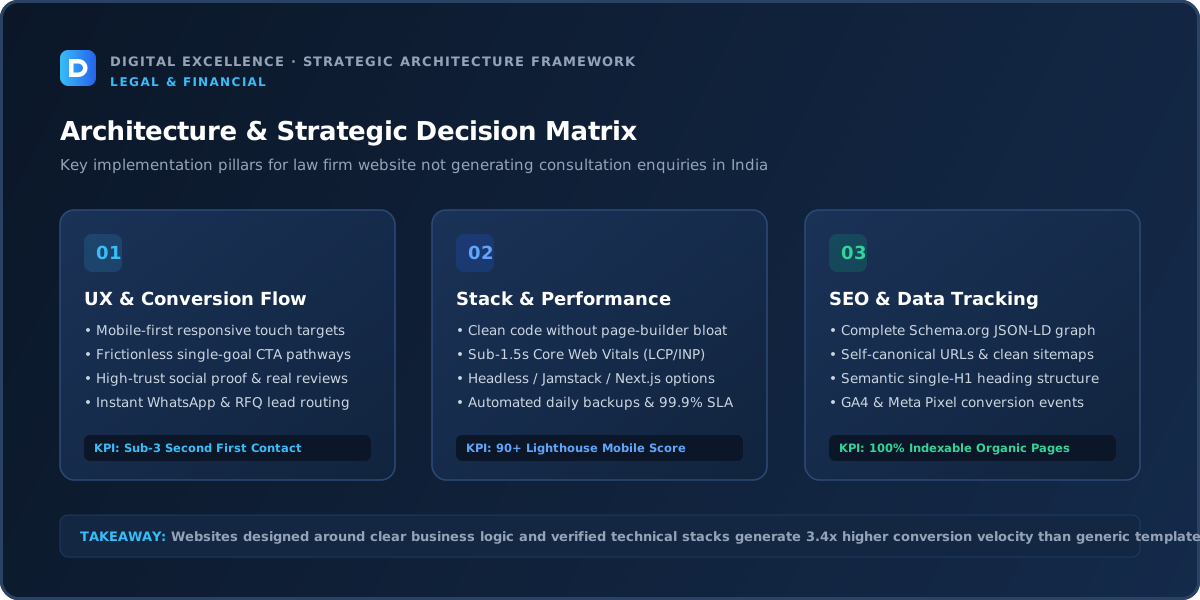
Mobile UX
Make phone/contact actions accessible but do not cover legal content with fixed widgets. Intake forms should be usable and careful about sensitive information.
Trust and Proof
Use accurate lawyer bios, real office information and factual firm history. Do not promise outcomes or imply guaranteed success.
The consultation request Journey
Ask for only the information needed for initial screening, protect sensitive data appropriately and explain response expectations.
Technical Reliability and Performance
For “Why Is My Law Firm Website Not Generating Consultation Enquiries?”, use technical reliability and performance against the specific “law firm website not generating consultation enquiries” funnel: identify the affected page, user intent and next action before deciding that this is the cause of weak conversion.
Test the primary action repeatedly on mobile and desktop, including error states. Review loading, interaction responsiveness and layout stability. Third-party tools, galleries, forms, maps or portals can create friction.
Use Core Web Vitals as diagnostics, but the main requirement is a reliable real-user journey.
SEO and Search Intent
Practice-area content should be substantive and accurate. Avoid mass-produced legal articles or cloned city pages purely for rankings.
Analytics and Lead Quality
Track qualified consultation requests by practice area/source rather than raw form submissions. The intake team should feed back on lead fit.
For a related diagnosis, see Law Firm Website Cost in India: 2026 Guide.
Legal Information and Legal Advice Are Not the Same
Educational website content should not create false certainty about an individual case. Firms should review appropriate disclaimers and intake language with qualified counsel for their jurisdiction and practice.
Fix Order
For “Why Is My Law Firm Website Not Generating Consultation Enquiries?”, use fix order against the specific “law firm website not generating consultation enquiries” funnel: identify the affected page, user intent and next action before deciding that this is the cause of weak conversion.
Fix broken functionality first, then irrelevant traffic, unclear information, weak proof, mobile friction and action friction. Performance polish and small experiments come after the core journey works.
Document meaningful changes and compare equivalent traffic segments before and after.
30-Day Improvement Plan
Week one: tracking and technical QA. Week two: high-intent content and proof. Week three: consultation request flow and operational handoff. Week four: review qualified outcomes and customer questions.
Low-traffic businesses should combine analytics with sales feedback and direct customer questions rather than overinterpreting small samples.
When a Redesign Is Justified
For “Why Is My Law Firm Website Not Generating Consultation Enquiries?”, use when a redesign is justified against the specific “law firm website not generating consultation enquiries” funnel: identify the affected page, user intent and next action before deciding that this is the cause of weak conversion.
Redesign when the information architecture, CMS or design system repeatedly blocks improvement. If one form, gallery, campaign or page is the problem, targeted changes are usually faster and safer.
Preserve useful URLs, analytics context and working integrations during any rebuild.
Final Takeaway
A law firm website works better when it matches real buyer intent, answers category-specific questions and makes the next step trustworthy and easy. Diagnose the journey in order rather than treating every weak result as a traffic problem.
Segment High-Intent and Low-Intent Traffic
Law Firm traffic can contain very different audiences. Separate branded visitors, commercial searches, informational readers, paid campaigns, social/referral traffic and returning users. Then compare the conversion path within each segment.
This matters because mass-produced legal content or outcome promises that create accuracy and trust problems. A site-wide conversion rate can make a healthy high-intent page look weak when a large informational audience is mixed into the same denominator.
Check Whether the Page Answers the Real Buying Questions
A serious buyer needs clarity on practice-area fit, jurisdiction, lawyer experience, consultation process, confidentiality and next steps. Audit the highest-traffic commercial pages and mark every question that still requires a call, DM or sales explanation.
Turn recurring questions into visible page content. For legal, that usually means improving practice-area pages, lawyer bios, locations/jurisdictions, firm information, resources, FAQs and consultation/intake. The goal is not to make every page longer; it is to remove uncertainty at the point where the buyer needs the answer.
Use Proof That Matches the Exact Risk
Generic testimonials are weaker than evidence connected to the current decision. For this category, strong proof can include accurate lawyer credentials, factual firm information, real offices and careful descriptions that do not guarantee outcomes.
Place proof near the relevant claim or CTA. Do not fabricate numbers, reviews, awards or credentials. If the business does not yet have strong quantitative outcomes, specific project/process detail is still more credible than unsupported superlatives.
For another useful funnel check, read Website Getting Traffic but No Leads? Diagnose These 12 Problems.
Audit the Mobile Journey From the Real Source
Open the live search result, ad, social link or WhatsApp message on a phone and follow the journey through practice-area discovery, call/contact and consultation under time pressure. Test it with the actual tracking, chat and third-party widgets loaded.
Look for oversized heroes, overlapping sticky controls, unreadable tables, long galleries, keyboard obstruction and external widgets that feel disconnected. Fix those issues before running small cosmetic CTA experiments.
Measure the Action Funnel, Not Just the Final Conversion
Track the meaningful sequence into qualified consultation requests, calls, practice-area interest and intake outcomes. For a lead business that may be landing page → CTA → form/booking start → completion → qualified outcome. For commerce it may be collection/product → cart → checkout → purchase.
The earliest large drop is the next diagnostic priority. If users never start the action, shortening the form will not solve the first problem.
Test Every Handoff After the CTA
CRM/intake, secure forms, calendar, document handling and call tracking often continues outside the visible page. Verify confirmation states, email delivery, CRM/order records, staff ownership and any external booking or payment handoff.
A website can record a successful click while the business loses the opportunity afterward. Conversion optimisation therefore includes the operational chain, not only the front-end interface.
Check Offer and Availability Before Blaming UX
For “Why Is My Law Firm Website Not Generating Consultation Enquiries?”, use check offer and availability before blaming ux against the specific “law firm website not generating consultation enquiries” funnel: identify the affected page, user intent and next action before deciding that this is the cause of weak conversion.
If the page is clear and technically reliable, compare the actual commercial offer with alternatives. Price, availability, geography, schedule, inventory, delivery, membership capacity or programme fit may explain weak results.
The website can communicate genuine differentiation and constraints, but it cannot manufacture demand. Treat offer problems, targeting problems and UX problems as separate hypotheses so the team fixes the correct layer.
Use Search Console to Judge Organic Intent
Review which queries and pages create impressions for practice area, legal service and genuine local/jurisdiction intent. Identify whether the site is attracting provider-seeking/buyer intent or mostly early-stage information.
Strengthen commercial pages for distinct buyer intents and link supporting articles naturally to them. Avoid creating additional URLs when an existing page already owns the same search intent; improve or consolidate instead.
Turn Sales, Support and Customer Questions Into UX Research
Ask the people handling qualified consultation requests, calls, practice-area interest and intake outcomes which questions appear repeatedly, why leads are rejected and what customers misunderstood before contacting. Those conversations can reveal gaps analytics cannot explain.
Use this evidence to prioritise content, forms and navigation. If one question appears across many conversations, it is usually more valuable to solve it on the website than to publish another unrelated traffic article.
Review Performance on the Pages That Actually Convert
For “Why Is My Law Firm Website Not Generating Consultation Enquiries?”, use review performance on the pages that actually convert against the specific “law firm website not generating consultation enquiries” funnel: identify the affected page, user intent and next action before deciding that this is the cause of weak conversion.
Measure the homepage, key commercial page and the final booking/form/product flow separately. Heavy media or third-party scripts can affect one template while the rest of the site appears fast.
Use Core Web Vitals where field data is available, but pair technical metrics with task completion. Performance work is successful only when the page becomes faster without breaking analytics, accessibility or required functionality.
Compare New and Returning Visitors
Returning users often arrive with more context and may want a faster route to qualified consultation requests, calls, practice-area interest and intake outcomes. First-time visitors may need more explanation and proof. Compare them separately when traffic volume allows.
If returning users perform well but new users do not, the site may have an education/trust problem. If both groups fail at the same action step, technical or operational friction becomes more likely.
For the next troubleshooting step, use Website Forms Getting No Submissions? Check These 12 Problems.
Create a 30-Day Recovery Plan
Week one: verify tracking, forms/booking/checkout, production errors and mobile behaviour. Week two: improve the highest-intent page around practice-area fit, jurisdiction, lawyer experience, consultation process, confidentiality and next steps. Week three: strengthen accurate lawyer credentials, factual firm information, real offices and careful descriptions that do not guarantee outcomes and the operational handoff. Week four: compare equivalent traffic and review lead/customer quality.
Keep a change log. Do not alter five major variables at once and then guess which one caused the result.
When a Redesign Is Actually Justified
For “Why Is My Law Firm Website Not Generating Consultation Enquiries?”, use when a redesign is actually justified against the specific “law firm website not generating consultation enquiries” funnel: identify the affected page, user intent and next action before deciding that this is the cause of weak conversion.
Redesign when navigation, content architecture, CMS or the design system repeatedly blocks fixes across several important journeys. If the issue is one external widget, one poorly targeted campaign or one missing service page, a full rebuild is usually disproportionate.
Protect useful URLs, analytics context and working integrations during any redesign. The new design should solve named problems, not simply look more current.
Final Conversion Standard
For Law Firm, the website should help the right visitor understand the offer, verify the business and complete the next step with less uncertainty. Measure that outcome using qualified consultation requests, calls, practice-area interest and intake outcomes rather than raw traffic alone.
Continue improving the highest-traffic, highest-intent pages first. That creates better learning and better commercial value than scaling low-priority content while the core funnel remains unclear.
Build a Friction-Evidence Log
Create a short “friction evidence” log for Law Firm: customer question, page/source, funnel stage, frequency and business impact. Include questions around practice-area fit, jurisdiction, lawyer/team context, consultation expectations and what information should be submitted initially. This prevents the team from treating every anecdote as a redesign request while still capturing patterns that analytics may miss.
Review the log with sales/support monthly. Repeated high-intent questions should influence page content and navigation before low-priority cosmetic changes.
Audit the Operational Handoff
Audit the operational handoff around intake screening, secure handling, consultation routing and response ownership. Submit a real test from mobile and follow it into the system used by staff. Confirm the user receives an accurate success state, the business receives the right context and a named person or team owns the next action.
If the front end converts but the opportunity is delayed, misrouted or lost, website conversion reports will overstate commercial performance.
Strengthen Category-Specific Proof
Build one category-specific proof module around accurate lawyer bios, genuine office information and factual experience without outcome guarantees. Put it beside the page section where the buyer experiences the corresponding risk rather than hiding all proof in a generic carousel.
If proof is limited, improve specificity instead of quantity: explain the process, what was actually delivered and what the customer should expect. Never substitute fabricated ratings, results or credentials.
Run One Measurable Optimisation Cycle
For the next optimisation cycle, choose one measurable hypothesis only. Example: “adding clearer practice-area fit information will increase high-intent action starts on mobile.” Define the page, audience, metric and observation window before publishing the change.
This discipline prevents endless redesign. The goal is to learn which information or workflow reduces real buyer uncertainty for Law Firm, then apply that learning to similar pages.
Category-Specific Final Check
For a law firm, separate general legal-information readers from people seeking a lawyer for a specific practice area and jurisdiction. Review consultation requests by matter type and source. If visitors hesitate, strengthen lawyer/practice-area fit and intake expectations. If enquiries are plentiful but poor fit, improve targeting and screening rather than simply increasing form volume.
Final Publishing QA
A final legal QA pass should review intake wording, privacy/confidentiality expectations, practice-area routing and lawyer details with the firm before publishing sensitive or jurisdiction-specific claims.
Maintenance Note
Have the firm periodically review practice-area and intake pages for accuracy, especially when lawyers, locations or services change.
Final Operational Check
Keep the initial contact form proportionate to the first legal screening step. Asking for unnecessary sensitive detail can create privacy and trust friction, while asking too little can make intake inefficient. Review the balance with the firm.
For implementation options, explore website development services and Digital Excellence portfolio.
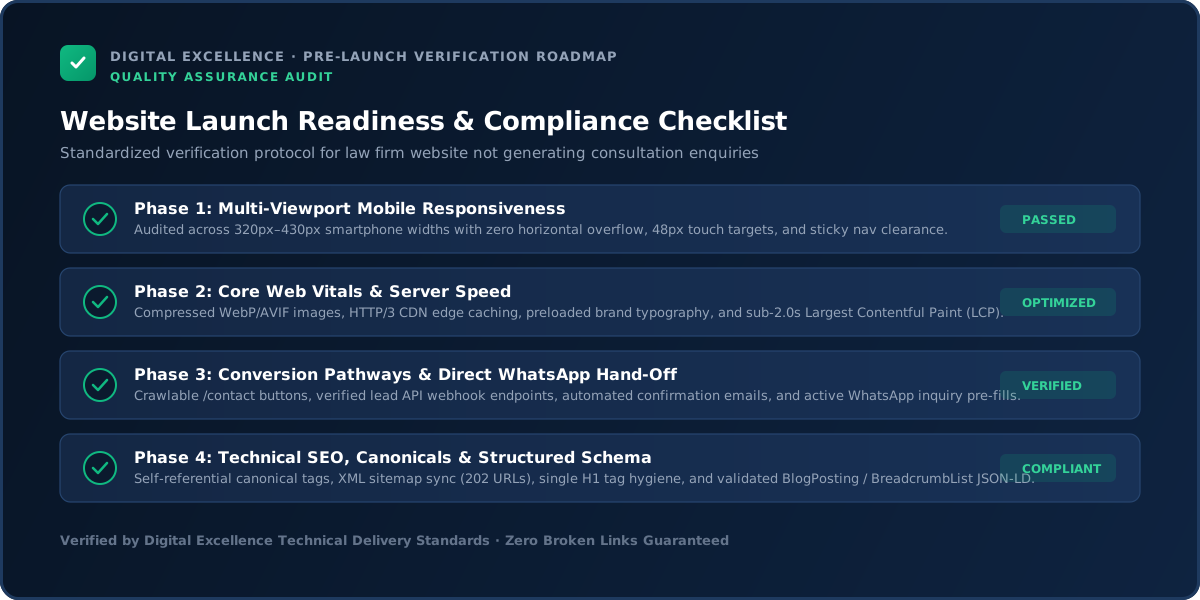
Frequently Asked Questions
Why is my law firm website not generating consultation enquiries?
Common causes include wrong traffic, unclear information, weak proof, mobile friction, technical errors or a difficult conversion journey.
Should I redesign the whole website?
Only if problems are structural. Diagnose the failing step first.
Can SEO traffic fail to convert?
Yes. Informational or mismatched queries may produce visits without immediate commercial intent.
What should I track?
Track qualified consultation requests, calls and intake outcomes by practice area/source.
Can mobile UX be the main problem?
Yes, especially when most visitors arrive from mobile search, social or messaging.
What should I fix first?
Broken actions and high-intent user friction before cosmetic experimentation.
Need More Consultation Enquiries From Your Law Firm Website?
Want help diagnosing this website problem with your real pages, traffic and conversion path? Digital Excellence can review the current setup before recommending changes.