Custom Website vs WordPress

“Custom website” and “WordPress website” are often presented as opposites, but the reality is more nuanced. WordPress itself can be customised heavily. A developer can build a completely original WordPress theme and still use WordPress only as the content-management layer. At the same time, a so-called custom website may use frameworks, libraries and managed services rather than being written from zero. The real decision is how much of your project's behaviour should be handled by an established CMS and how much needs to be engineered specifically for your business. For a normal service business, WordPress can be faster, easier to edit and less expensive. For a SaaS product, portal, marketplace or business with unusual workflows, custom development may provide a cleaner architecture. This guide explains the trade-offs without assuming that more custom code automatically means a better website.
Table of Contents
- What Does “Custom Website” Actually Mean?
- What WordPress Is Best At
- Cost Comparison
- Speed to Launch
- Design Flexibility
- Functionality and Integrations
- SEO: Can Custom Websites Rank Better Than WordPress?
- Performance
- Security and Maintenance
- Content Management
- Scalability
- Ownership and Vendor Dependence
- Which Option Fits Which Project?
- Final Takeaway
- Custom Development Cost: What Are You Paying For?
- WordPress Can Still Be Part of a Custom Architecture
- How to Avoid Overengineering
- Questions to Ask Before Choosing WordPress or Custom
- One Final Decision Rule
- Frequently Asked Questions
What Does “Custom Website” Actually Mean?
Custom development means the architecture and functionality are designed around your requirements rather than primarily around a pre-built CMS theme or plugin stack. Modern custom websites still use frameworks such as React or Next.js, databases, APIs and cloud services. Developers are not usually reinventing every basic technology.
Custom development can cover the frontend only, the backend only or both. For example, a company might use a headless CMS for content but build a custom Next.js frontend. Another business may use WordPress for marketing pages and a separate custom customer portal.
The important distinction is not “template versus code.” It is how much unique software behaviour your business needs.
What WordPress Is Best At
WordPress is strong when the website is primarily content: marketing pages, service pages, articles, case studies, team profiles and forms. It gives editors an established admin interface and a large ecosystem of themes and plugins.
For a typical business website, many requirements have already been solved. Building a custom content editor, media library and publishing workflow from scratch would add cost without creating much business value.
WordPress becomes less comfortable when the website behaves more like software than publishing. Complex real-time interactions, unusual permissions, product logic or highly specialised workflows can turn into a stack of plugins and workarounds.
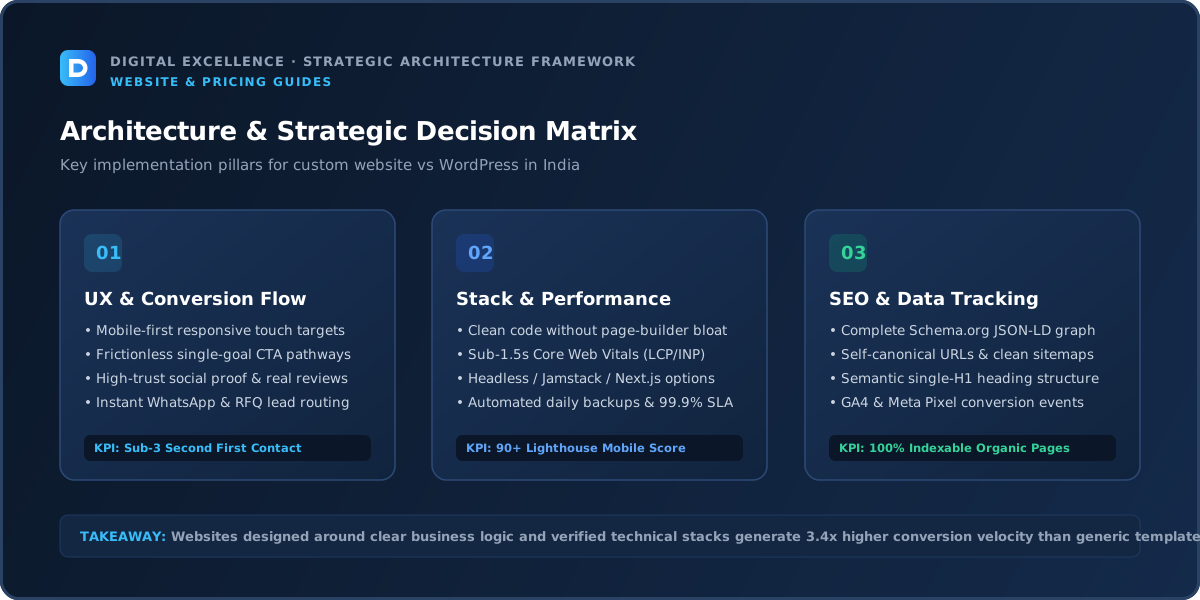
Custom Website vs WordPress
| Factor | WordPress | Custom Development |
|---|---|---|
| Upfront cost | Usually lower | Usually higher |
| Launch speed | Usually faster | More planning/build time |
| Content editing | Mature CMS | Must be designed or integrated |
| Standard business features | Large plugin ecosystem | Must be built/integrated |
| Unique workflows | Possible but can become complex | Strong fit |
| Infrastructure control | Moderate to high | Very high |
| Maintenance | Core/theme/plugin updates | Code/dependency/infrastructure maintenance |
| Best fit | Marketing/content/service sites | Apps, portals, unique systems |
Cost Comparison
WordPress is generally cheaper for standard websites because content management, user roles and common functionality already exist. A professional WordPress site may still require custom UI, development and SEO, but the project starts with more infrastructure.
Custom development usually costs more because the team must define architecture, data structures, components, APIs and deployment. It can still be the cheaper long-term option if the alternative is forcing a complex business workflow into dozens of plugins and custom patches.
Compare lifecycle cost. The lowest initial build is not automatically the most economical if every future change is difficult.
Speed to Launch
WordPress can launch quickly when requirements are familiar. Developers can use proven components for forms, content and administration. This is useful for businesses that need a professional marketing site without months of product development.
Custom development needs more discovery and testing, especially when the functionality is unique. However, modern frameworks and managed services can still support rapid builds when the scope is clear.
Do not choose custom development merely because you want a premium-looking site. Premium visual design can be implemented on WordPress too.
Design Flexibility
Both approaches can support highly customised design. WordPress is not limited to off-the-shelf themes. A developer can build custom templates, blocks and interactions while retaining the WordPress CMS.
Custom frameworks offer complete frontend control and can be useful for application-like interactions, complex animation systems or deeply integrated experiences. They also let developers optimise component architecture around the exact product.
Design flexibility should therefore not be the main deciding factor. Functionality, content workflow and maintenance are usually more important.
For a related buying decision, see WordPress Website Development Cost in India : Pricing Guide.
Functionality and Integrations
WordPress plugins can handle bookings, memberships, ecommerce, forms, multilingual content and many other needs. For common requirements, this saves time.
Problems appear when the business needs a workflow that no plugin models cleanly. Stacking extensions can create conflicting data structures, duplicated features and difficult updates. At that point, custom development may produce a simpler system even though the initial build costs more.
List every integration and workflow before choosing the platform. A website with one CRM form is very different from a portal that synchronises users, payments and operational data across several systems.
SEO: Can Custom Websites Rank Better Than WordPress?
Both can rank. WordPress provides convenient publishing tools and SEO plugins, but those tools do not create rankings by themselves. Custom websites can have excellent technical SEO when developers implement metadata, structured data, crawlable links, sitemaps and rendering correctly.
The risk in custom JavaScript applications is neglecting crawlability because the team is focused on software functionality. The risk in WordPress is publishing too much duplicated or low-value content through themes, archives and plugins.
The best SEO platform is the one implemented cleanly around useful content and search intent.
Performance
A lean custom frontend can be extremely fast because developers control what code and assets are shipped. WordPress can also perform very well with lightweight themes, caching, good hosting and disciplined plugins.
Poor implementation can make either platform slow. A custom React site can ship excessive JavaScript. A WordPress site can load dozens of plugin scripts. Performance is an engineering outcome, not a platform guarantee.
Ask how images, fonts, scripts, caching and third-party tools will be handled.
Security and Maintenance
WordPress has a large ecosystem and therefore needs regular core, theme and plugin updates. Secure hosting, backups and careful plugin selection reduce risk.
Custom applications also require maintenance. Frameworks and packages update, vulnerabilities are discovered, cloud services change and integrations evolve. Custom code does not eliminate maintenance—it changes the type of maintenance.
The correct comparison is who will be responsible, what needs updating and how quickly issues can be handled.
For a useful scope comparison, read Custom Web App Cost in India: 2026 Guide.
Content Management
WordPress is difficult to beat when non-technical teams need to publish regularly. Editors understand pages, posts, media and revisions.
A custom website can connect to a headless CMS or custom admin panel, but that editing experience must be selected or developed. This is worthwhile when the content model is unique, but unnecessary for many business sites.
Ask your marketing team what they need to change without a developer. Those answers should influence the architecture.
Scalability
Scalability is often used vaguely. A website may need to scale traffic, content, products, users, transactions or internal workflows.
WordPress can handle large content sites when infrastructure and development are strong. Custom applications can be designed around very specific scaling requirements. Neither automatically scales better in every dimension.
Define what you expect to grow. A service website receiving more traffic does not require the same architecture as a SaaS application adding thousands of authenticated users.
Reversibility is an important part of the custom-versus-WordPress decision. Whichever approach you choose, keep the domain, analytics, critical accounts and content under business control. Ask how another competent developer would take over the project and what documentation or repository access would be available.
Custom development should create flexibility, not dependence on one person. WordPress should create editability, not dependence on a fragile collection of plugins. Long-term ownership is therefore a better decision factor than a simple “custom is premium” or “WordPress is cheaper” rule.
Ownership and Vendor Dependence
With WordPress, businesses can usually move hosting and find another developer relatively easily if the site follows common practices. Custom applications may require more specialised knowledge, so documentation and repository access are especially important.
In both cases, your business should control the domain, hosting or cloud accounts where practical, analytics and important third-party services. Avoid unnecessary lock-in.
Good architecture includes a handover plan, not only a launch plan.
Which Option Fits Which Project?
WordPress is usually sensible for service businesses, agencies, consultants, blogs, news or resource sites, local businesses and many content-driven company websites.
Custom development becomes attractive for SaaS, marketplaces, customer portals, custom dashboards, workflow systems, unusual booking logic, complex B2B experiences and websites that are effectively software products.
There is also a middle ground: custom-designed WordPress. Many businesses need unique visuals but standard content functionality. That combination can deliver originality without unnecessary backend engineering.
For the next planning step, use WordPress Developer Cost in India.
Final Takeaway
The custom website vs WordPress decision should be based on functionality and ownership, not prestige. WordPress is a mature tool for publishing and common business requirements. Custom development provides freedom when the business needs software behaviour that an existing CMS cannot model cleanly.
Use the simplest architecture that can support your real requirements for the next few years. Complexity should be purchased only when it creates clear value.
Custom Development Cost: What Are You Paying For?
Custom projects require more than frontend coding. The team may need to model data, design APIs, create authentication, define permissions, set up environments, connect services, monitor errors and test edge cases. These tasks are mostly invisible in screenshots but determine whether the application is reliable.
The more unique the workflow, the less useful a generic page-count quote becomes. A single dashboard with five roles can require more engineering than a 30-page marketing site. When comparing proposals, ask which backend, integrations and admin features are included.
WordPress Can Still Be Part of a Custom Architecture
The choice is not always binary. WordPress can act as a headless CMS while a custom frontend handles presentation. A custom application can also coexist with a WordPress marketing site on the same brand.
This hybrid approach can give marketing teams familiar publishing tools while developers keep application logic separate. It adds architectural complexity, so it should only be used when both sides create real value.
For many companies, a normal custom WordPress theme remains simpler. Use hybrid architecture because of workflow needs, not because it sounds technically impressive.
How to Avoid Overengineering
Start with the user problem and launch requirements. If the business needs pages, forms and content, use a CMS. If it needs accounts, dashboards and workflows, identify exactly which parts require custom software.
Avoid building your own CMS, authentication system or ecommerce engine when mature services already solve the requirement safely. Custom development should focus on the parts that differentiate the business.
This approach reduces build time, lowers maintenance burden and leaves more budget for UX, content and features customers can actually see.
Questions to Ask Before Choosing WordPress or Custom
Ask who will edit content, how often features will change, what integrations are required, whether users need accounts, what data must be stored, and how the product is expected to grow. Ask who will maintain the code after launch and what recurring infrastructure costs exist.
If the answers are mostly about content and marketing, WordPress is often a strong candidate. If the answers involve complex workflows and application logic, custom development deserves serious consideration.
One Final Decision Rule
If removing WordPress would force you to rebuild common publishing features with no clear business benefit, keep the CMS. If keeping WordPress forces the core product into layers of workarounds, consider custom development. That simple test usually reveals where the real complexity belongs.
For implementation options, explore website development services and Digital Excellence portfolio.
Frequently Asked Questions
Is a custom website better than WordPress?
Not automatically. Custom development is better when unique functionality justifies it. WordPress is often more efficient for content and standard business websites.
Is a custom website better for SEO?
No platform automatically ranks better. Technical implementation, content quality, internal links, performance and authority matter.
Is WordPress only for small websites?
No. WordPress can support large websites, but architecture, hosting and plugin discipline become more important as complexity grows.
Can WordPress have a completely custom design?
Yes. Developers can create custom themes and blocks while using WordPress as the CMS.
Which is easier to maintain?
For standard content websites, WordPress can be easier because the CMS is mature. Complex WordPress plugin stacks can be harder to maintain than a well-designed custom application.
When should I definitely consider custom development?
When the website requires unique user accounts, permissions, workflows, dashboards, integrations or application logic that standard CMS tools handle poorly.
Need Help Choosing the Right Architecture?
Need a website scope or quote based on your real requirements rather than a generic package? Digital Excellence can review the pages, platform, integrations, SEO needs and launch priorities.