Hire a Website Developer in India: Complete Buyer’s Guide

Searching “hire website developer India” usually means you have moved past general research. You need someone to build, rebuild or improve a website and now have to decide whom to trust. The difficult part is not finding developers. India has freelancers, small studios, specialised Shopify and WordPress teams, large agencies and custom software companies. The difficult part is identifying which type of provider matches your project and then comparing proposals that may use the same words—responsive, SEO-friendly, fast, custom—while meaning very different things. This guide gives you a practical hiring process from the first brief to final handover. It is written for business owners who want a website that remains useful after launch, not just a design that looks impressive in a proposal.
Table of Contents
- Step 1: Write a One-Page Website Brief
- Step 2: Choose the Right Type of Developer
- Step 3: Review Live Work Like a Customer
- Step 4: Ask the Developer to Recommend a Platform
- Step 5: Compare Scope Line by Line
- Step 6: Check Mobile Readability and Conversion Basics
- Step 7: Clarify SEO Before You Hire
- Step 8: Confirm Ownership and Access
- Step 9: Understand the Timeline and Your Responsibilities
- Step 10: Read the Payment and Change Terms
- Step 11: Ask About Handover and Post-Launch Support
- Step 12: Run a Final Decision Scorecard
- Final Takeaway
- How to Interview a Website Developer Without Turning It Into a Technical Exam
- How to Verify SEO Capability Before Hiring
- How to Judge a Developer's Mobile Work
- What to Check in a Development Contract
- A 30-Minute Final Due-Diligence Routine
- How to Compare Two Strong Developers Who Both Look Good
- A Better Way to Run the First Week After Hiring
- What to Keep in Writing
- How to Judge the First Deliverable
- Frequently Asked Questions
Buyer Comparison
| Stage | What to verify | Red flag |
|---|---|---|
| Shortlist | Relevant live portfolio | Only mockups/screenshots |
| Discovery | Asks about business goals | Jumps straight to a price |
| Proposal | Clear scope and exclusions | Vague “complete website” |
| Technology | Explains trade-offs | Same platform for every project |
| Ownership | You control key accounts | Developer owns domain without transfer terms |
| Launch | QA, analytics, SEO checks | “Upload and done” |
| Support | Defined handover/maintenance | No post-launch process |
Step 1: Write a One-Page Website Brief
A useful brief explains the business, target customer, primary website goal, services or products, required pages, desired functionality, content readiness and launch deadline. It does not need to be a 40-page specification.
Separate must-haves from ideas. “Customers must be able to book a consultation” is a requirement. “Maybe add a chatbot, calculator and AI assistant” can sit in phase two.
A clear brief helps competent developers give better estimates and makes proposals comparable. Without it, every vendor quotes a different imagined project.
Step 2: Choose the Right Type of Developer
A freelancer can be excellent for a focused site, a specialised Shopify build or ongoing development. A small agency is useful when you need design, development and support under one roof. A custom software team makes more sense when the website behaves like a product or portal.
Specialisation matters. A developer who builds ecommerce every week may be a better fit for a store than a general agency with a beautiful corporate portfolio. A WordPress specialist can be more efficient than a React team for a content-led service website.
Choose for the work you actually need, not the size of the vendor's office.
Step 3: Review Live Work Like a Customer
Do not stop at screenshots. Open the developer's projects on desktop and mobile. Click navigation, filters, forms and CTAs. Read the copy. Check whether pages feel coherent and whether interactive elements work.
For ecommerce, examine collection pages, product pages, search, cart and mobile product selection. For lead-generation sites, look at service clarity, proof and enquiry paths.
Ask which parts of each project the developer personally delivered. A portfolio can include work done as part of a larger team, which is fine as long as the contribution is clear.
Step 4: Ask the Developer to Recommend a Platform
A good developer should explain why WordPress, Shopify, WooCommerce, Next.js or another platform fits your use case. Listen for trade-offs rather than slogans.
If every project is pushed toward the same stack, the recommendation may reflect the provider's comfort rather than your needs. A normal service website usually does not need a custom application backend. A complex membership portal should not be forced into a brittle page-builder setup.
The best architecture is normally the simplest system that supports the required workflows cleanly.
Step 5: Compare Scope Line by Line
Proposal titles are marketing. Scope is what you are buying. Compare unique templates, mobile states, forms, CMS editing, product uploads, migrations, integrations, copywriting, SEO, analytics, performance, testing, revisions and support.
Ask what is explicitly not included. This question often reveals more than the features list.
If one proposal is half the price, identify which responsibilities have been removed. Sometimes that is a smart saving. Sometimes it means you will have to buy the missing work later.
For a related buying decision, see Website Developer Cost in India : Pricing Guide.
Step 6: Check Mobile Readability and Conversion Basics
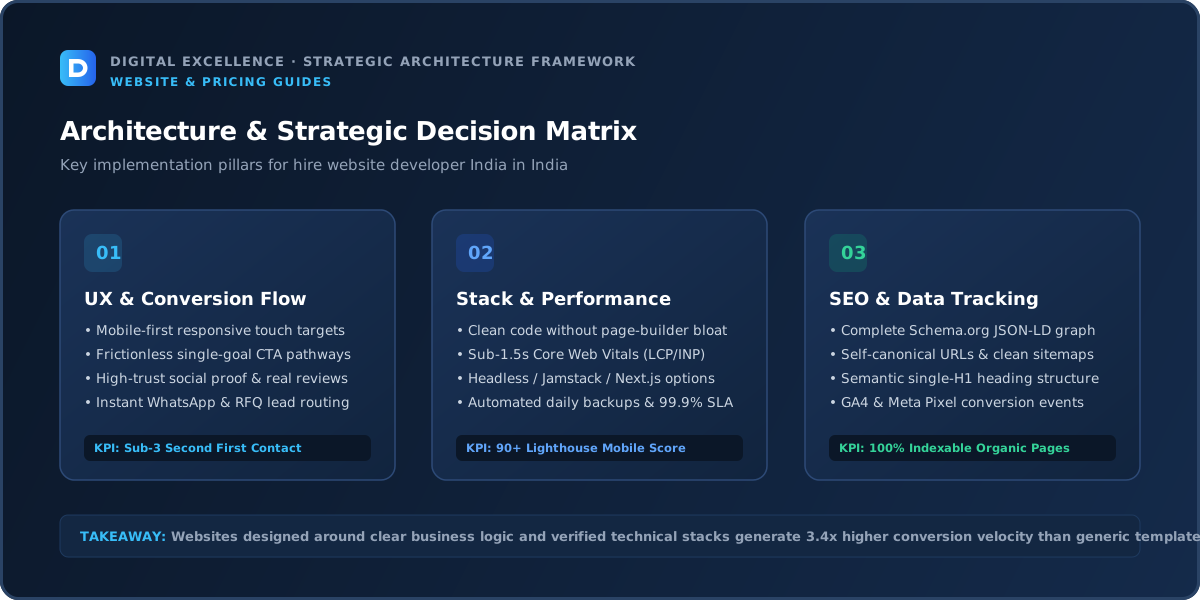
A website can technically be responsive and still be unpleasant to use. Look for readable typography, clear tap targets, compact navigation, responsive tables, forms that fit the screen and floating buttons that do not cover content.
If your customers come from Instagram, Meta Ads or Google mobile search, mobile UX may affect more visitors than desktop design.
Ask whether the developer designs responsive states intentionally or simply lets the desktop layout shrink.
Step 7: Clarify SEO Before You Hire
“SEO-friendly” is too vague. Ask about URL structure, page titles, meta descriptions, H1/H2 hierarchy, internal links, canonical tags, sitemap, robots, structured data, image alt text and redirects.
Technical and on-page foundations do not guarantee rankings. Ongoing SEO may require content, optimisation, digital PR or links. The proposal should distinguish these.
If you are redesigning an existing ranked website, migration planning is especially important. Old URLs cannot be discarded casually.
Step 8: Confirm Ownership and Access
Your business should have control or clear transfer rights for the domain, hosting or deployment account, CMS, analytics, Search Console and important third-party services.
For custom code, clarify repository access and intellectual-property terms. For Shopify, the store should sit in your business account. For WordPress, you should have administrator and hosting access.
Ownership questions feel administrative until a relationship ends. Then they become critical.
Step 9: Understand the Timeline and Your Responsibilities
A developer cannot keep a deadline if content, approvals or third-party accounts arrive weeks late. Ask for milestones and a list of what they need from you.
Assign one decision-maker internally. Consolidated feedback is faster than five stakeholders giving separate instructions.
If the launch date is fixed, define what can move to phase two. Protecting scope is more reliable than compressing QA at the end.
Step 10: Read the Payment and Change Terms
Understand the deposit, milestone payments and final payment. Ask what triggers a payment and what happens if either side pauses the project.
Scope changes should have a simple process: describe the request, estimate time/cost and approve it before work begins.
Be cautious with arrangements that require full payment before meaningful work exists unless the vendor's reputation and contract justify it.
For a useful scope comparison, read Choose a Website Development Company in India.
Step 11: Ask About Handover and Post-Launch Support
A professional handover may include admin access, repository access, domain/hosting information, analytics, plugin/app details and basic training.
Define what happens if a form stops working the week after launch. Some providers include a warranty period; others move immediately to paid maintenance.
Maintenance should also be defined. Security updates and backups are different from designing new pages or adding features.
Step 12: Run a Final Decision Scorecard
Score shortlisted providers on relevant portfolio quality, understanding of the business, platform reasoning, scope clarity, mobile UX, SEO knowledge, ownership, timeline, support and total cost.
Do not assign 50% of the score to price. The cheapest developer can be the best choice, but only after the scope and risk are comparable.
Use the scorecard to expose trade-offs, not to create fake mathematical certainty.
Final Takeaway
For “Hire a Website Developer in India: Complete Buyer’s Guide”, use final takeaway to compare the real scope, responsibility and long-term ownership behind each proposal instead of treating it as a standard line item.
The right decision comes from matching scope, risk and ownership to the business—not chasing the lowest headline price. Use this guide as a buying framework, verify every promise in the proposal and keep the website easy to operate after launch.
How to Interview a Website Developer Without Turning It Into a Technical Exam
You do not need to test obscure programming knowledge. Ask the candidate to explain a recent decision: why they chose a platform, how they simplified a feature, how they handled a mobile problem or what they would do differently today. Clear explanations reveal judgement better than jargon.
Describe one real scenario from your business and ask them to think aloud. For example: “Most leads come from mobile Instagram traffic and users need to book a call—how would you structure the page?” A strong answer should connect design and technology to the user journey, not only list tools.
How to Verify SEO Capability Before Hiring
Ask the developer to explain the difference between technical SEO, on-page SEO and ongoing organic growth. They should understand crawlable navigation, canonical URLs, sitemaps, metadata, redirects, structured data where appropriate and page performance. They should also be comfortable saying that no developer can guarantee a number-one ranking.
If organic search is important, ask how service pages and blog content will be internally linked and how a redesign will preserve old URLs. Google explicitly recommends crawlable contextual internal links so both users and search engines can discover important pages. The response should be practical rather than a promise to “submit the website to Google.”
How to Judge a Developer's Mobile Work
Open at least three portfolio sites on your phone. Check whether headings wrap cleanly, menus are easy to use, images stay sharp without being huge, forms fit the screen, tables scroll or transform properly and floating buttons do not cover content.
Then resize a desktop browser and test intermediate widths such as tablets. Many weak builds are optimised only for one desktop size and one mobile breakpoint. If your website will publish long-form SEO content, also inspect article typography. A developer who can make a 2,000-word page comfortable to read is solving a different problem from someone who only builds visual hero sections.
What to Check in a Development Contract
The contract should identify the scope, payment milestones, intellectual-property or license terms, responsibilities, cancellation or pause conditions, timelines and change process. It should also state what happens to deposits and completed work if the project stops.
For custom work, clarify source-code rights. For themes and plugins, clarify third-party licenses. For hosting or domains managed by the vendor, clarify transfer rights. You do not need a hostile contract; you need one that makes ordinary situations predictable.
For the next planning step, use How to Compare Website Development Quotes: 2026 Buyer Checklist.
A 30-Minute Final Due-Diligence Routine
Before you hire, spend ten minutes reviewing live work on mobile, ten minutes comparing the written scope against your brief and ten minutes checking ownership, recurring costs and support. Ask for clarification on every blank cell in your comparison sheet.
Then decide based on fit: relevant work, communication, platform reasoning, scope clarity, mobile quality, SEO foundations, ownership and total cost. This simple routine is more reliable than choosing from an impressive sales call or one testimonial screenshot.
For implementation options, explore website development services and Digital Excellence portfolio.
How to Compare Two Strong Developers Who Both Look Good
When two candidates both have relevant work, compare how they reason rather than how confidently they sell. Give both the same short brief and ask what they would simplify, which platform they would choose, what they see as the biggest project risk and what they need from you before starting. Differences in judgement often become visible quickly.
Also compare the quality of the written proposal. A developer who turns the conversation into a clear scope, milestones and ownership model is easier to evaluate than one who relies on verbal promises. The goal is not to find the person who agrees with every idea; it is to find someone who can explain trade-offs and make the project more predictable.
A Better Way to Run the First Week After Hiring
Use the first week to lock the information architecture, collect missing content, confirm account access and agree on how feedback will be given. Name one person who can approve decisions. Set a predictable update rhythm instead of sending changes through several channels.
For a fast project, these operational details matter as much as coding speed. A developer can lose days waiting for copy, product data, DNS access or conflicting feedback. A simple launch checklist and shared source of truth can protect both quality and timeline.
What to Keep in Writing
Keep the final scope, exclusions, timeline, payment milestones, approved designs, change requests and handover terms in writing. This does not require heavy bureaucracy; a clear email or project document can prevent major misunderstandings.
If a feature is discussed on a call, add it to the written scope before assuming it is included. The same applies to SEO, content uploads, migration, analytics and maintenance. Written clarity is especially important when several people from either side are involved.
How to Judge the First Deliverable
Do not judge the first design only by whether it looks premium. Check whether it reflects the brief, prioritises the main customer action, works with real content and can adapt to mobile. Ask whether the layout can scale to future pages without becoming inconsistent.
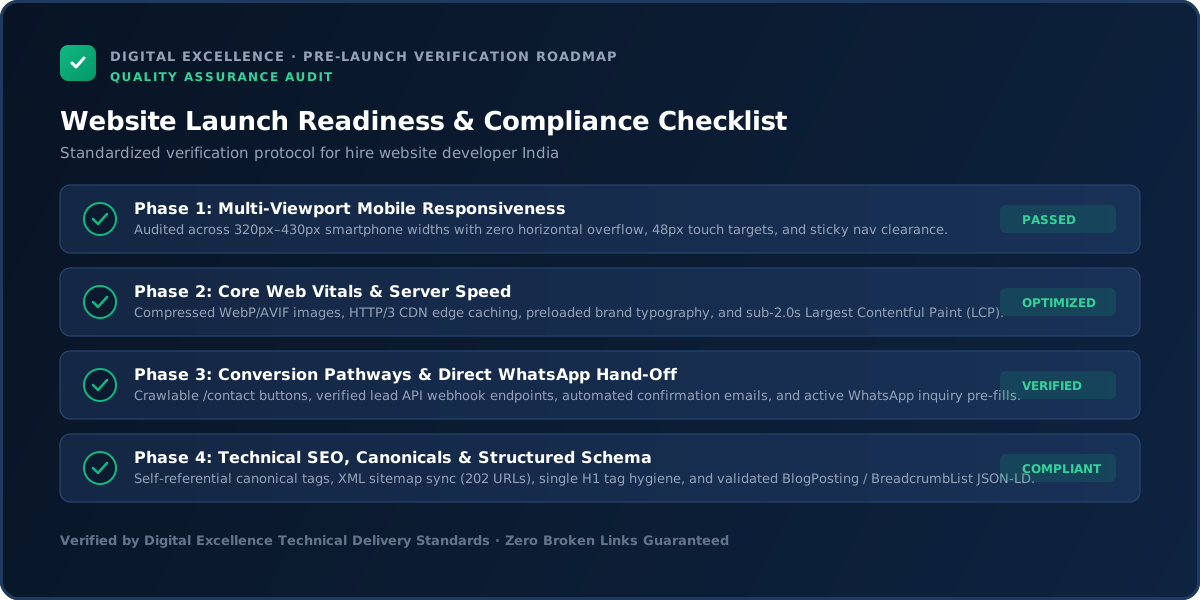
For development, verify actual interactions instead of reviewing screenshots. Test navigation, forms, responsive states and content editing. Early feedback should focus on structural issues before minor visual preferences, because structural changes become more expensive later.
Frequently Asked Questions
How do I find a good website developer in India?
Shortlist providers with relevant live work, verify mobile quality, ask for a written scope and check ownership, support and communication before hiring.
Should I hire a freelancer or an agency?
Choose based on complexity, skills required, deadline and support needs. A focused freelancer can be ideal for a clear project; a team can reduce single-person dependency for larger work.
What should I ask before paying a deposit?
Confirm scope, timeline, payment milestones, revisions, recurring costs, ownership, content responsibility and what happens after launch.
How can I tell whether a portfolio is genuine?
Ask for live links and the provider's role on each project. Test the websites yourself.
Should a web developer also do SEO?
They should understand technical and on-page foundations. Ongoing SEO may be a separate service.
What access should I receive at handover?
Appropriate domain, hosting/deployment, CMS, analytics, Search Console and source-code access depending on the stack.
Looking for a Website Developer?
Need a website scope or quote based on your real requirements rather than a generic package? Digital Excellence can review the pages, platform, integrations, SEO needs and launch priorities.