Freelancer vs Website Development Agency: Who Should You Hire?

The freelancer-versus-agency decision is often reduced to one line: freelancers are cheaper, agencies are safer. That is too simplistic. A senior freelancer can outperform a mediocre agency. A small specialist studio can offer agency-level continuity without large-agency overhead. A large team can be essential for a complex migration and completely unnecessary for a five-page business website. The useful question is not which category is “better.” It is which delivery model fits the risk, complexity and support requirements of your project. This guide compares freelancer vs website development agency across the factors that actually affect a business owner after the proposal is signed.
Table of Contents
- Cost: Why Freelancers Usually Start Lower
- Skill Coverage
- Communication and Decision Speed
- Single Point of Failure vs Team Continuity
- Design Quality and Specialisation
- Project Management
- Quality Assurance
- SEO and Content
- Post-Launch Support
- When a Freelancer Is the Better Choice
- When an Agency Is the Better Choice
- The Hybrid Option
- A Decision Framework
- Final Takeaway
- How Mobile Quality Changes the Freelancer-vs-Agency Decision
- How SEO Requirements Change the Decision
- How to Compare Availability and Support Risk
- How Pricing Models Differ
- What Ownership Should Look Like in Either Model
- A Scenario-Based Decision Test
- How to Compare a Senior Freelancer With a Small Specialist Agency
- When Direct Communication Is a Major Advantage
- How to Avoid Single-Person Dependency With a Freelancer
- How to Avoid Agency Lock-In
- Use Project Risk to Decide, Not Prestige
- The Decision Can Change Over Time
- One Final Hiring Principle
- Frequently Asked Questions
Buyer Comparison
| Factor | Freelancer | Agency |
|---|---|---|
| Upfront cost | usually lower | usually higher |
| Communication | direct | may include PM/account layer |
| Skill coverage | depends on individual | multiple specialists possible |
| Continuity | single-person risk | team backup possible |
| Speed | very fast for focused work | faster when parallel roles help |
| Process | can be lightweight | usually more formal |
| Support | depends on availability | structured plans more common |
| Best fit | defined projects | multi-disciplinary/critical projects |
Cost: Why Freelancers Usually Start Lower
Freelancers have less overhead. They may work from home, handle their own project management and specialise in one platform. That can produce excellent value.
Agencies must cover team salaries, management, software and operating costs. Their floor price is therefore higher.
Do not convert this into a quality rule. A lower-cost expert can be better than an expensive generalist. The cost difference tells you about the delivery structure, not automatically the output.
Skill Coverage
A website can involve research, copy, UI design, frontend, backend, SEO, analytics and QA. Some freelancers cover several areas well; others specialise.
Agencies can assign different people, but only if the agency actually has those capabilities. Ask who is on the project.
If your project is technically simple, multiple specialists may be unnecessary. If it includes custom ecommerce, migration and SEO, a broader team can reduce gaps.
Communication and Decision Speed
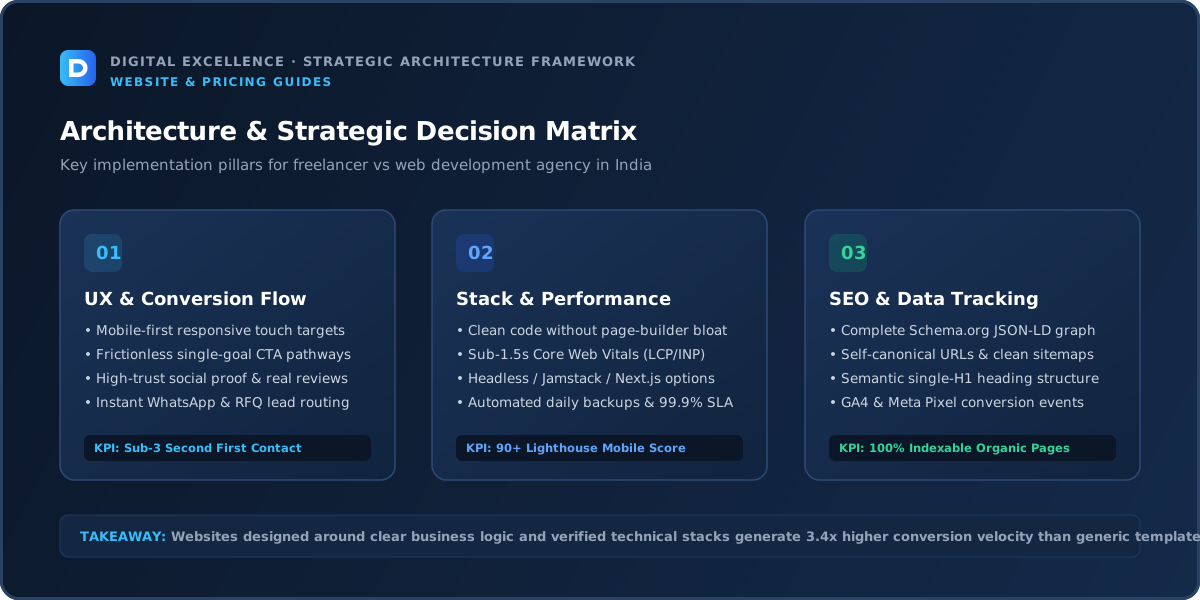
Freelancer communication is often direct: you speak with the person doing the work. Decisions can be fast.
Agencies may introduce project managers, which can improve organisation but also add layers. The quality of that process matters.
Ask how often updates happen, who approves changes and how urgent issues are escalated.
Single Point of Failure vs Team Continuity
A freelancer can become unavailable because of illness, workload or life events. Agencies can theoretically move work between team members.
That continuity is valuable when deadlines are commercially important. It is less important for a non-urgent brochure site.
Agencies are not immune to turnover. Ask how project knowledge is documented and what happens if the assigned developer changes.
Design Quality and Specialisation
A freelancer who focuses on premium Shopify design may be stronger than a full-service agency that only occasionally builds stores. Likewise, an agency with dedicated UX designers can outperform a developer who treats design as an afterthought.
Review work that resembles your requirement.
Specialisation often matters more than organisation size.
Project Management
With a freelancer, the client often has to make priorities clear and provide fast feedback. With an agency, project management may be included.
That structure becomes valuable when several stakeholders or workstreams are involved.
If your internal team is organised, you may not need to pay for much external project management. If nobody owns the project internally, a stronger agency process can prevent chaos.
Quality Assurance
Some freelancers test their own work thoroughly. Some agencies have dedicated QA. Neither should be assumed.
Ask about device testing, browser testing, forms, analytics, ecommerce flows, accessibility basics and launch checklists.
The existence of a QA role matters less than whether testing is systematic and visible.
For a related buying decision, see Web Development Agency Cost in India.
SEO and Content
If the project needs SEO architecture and copy, determine whether the freelancer or agency has actual editorial capability.
A developer can build a crawlable site but may not be the right person to research search intent or write persuasive service pages.
An agency can bundle these disciplines, but bundled services should still be evaluated independently.
Post-Launch Support
A freelancer may provide excellent long-term support because you have a direct relationship. An agency may offer service-level agreements and backup coverage.
Ask what happens after launch, not just during development.
If the site is revenue-critical, response expectations should be in writing.
When a Freelancer Is the Better Choice
Choose a freelancer when the scope is clear, the platform is familiar, the deadline is flexible enough for one person's availability and you value direct communication.
Examples include a landing page, a standard WordPress site, Shopify theme customisation or ongoing specialist development.
A senior specialist can be one of the most efficient ways to buy expertise.
When an Agency Is the Better Choice
Choose an agency when the project requires several disciplines at once, has a fixed commercial deadline, needs continuous support or involves a high-risk migration.
Agencies also help when your internal team needs one accountable vendor instead of managing separate designers, writers and developers.
The premium should buy coordination and continuity.
The Hybrid Option
Many businesses use a hybrid model: a lead freelancer plus specialist contractors, or a small studio that operates with a core team and trusted partners.
This can provide direct communication with broader coverage.
Judge the process, backup and ownership exactly as you would with any agency.
A Decision Framework
Ask four questions: How complex is the build? How many disciplines are required? How expensive would a delay be? How much ongoing support do we need?
If complexity and business risk are low, a freelancer often makes sense. If both are high, a team becomes easier to justify.
Then compare actual shortlisted providers rather than continuing to debate categories in the abstract.
For a useful scope comparison, read Choose a Website Development Company in India.
Final Takeaway
For “Freelancer vs Website Development Agency: Who Should You Hire?”, use final takeaway to compare the real scope, responsibility and long-term ownership behind each proposal instead of treating it as a standard line item.
The right decision comes from matching scope, risk and ownership to the business—not chasing the lowest headline price. Use this guide as a buying framework, verify every promise in the proposal and keep the website easy to operate after launch.
How Mobile Quality Changes the Freelancer-vs-Agency Decision
Mobile UX is a discipline that can be handled well by either model. A strong freelancer may design and code responsive states personally, while an agency may split the work between design and development. The risk is assuming that an agency automatically has better mobile quality or that a freelancer automatically has less process.
Review deliverables. Does the designer create mobile layouts? Does the developer test common widths? Are long articles, tables, forms and ecommerce controls considered? The actual process matters more than company size.
How SEO Requirements Change the Decision
If your website is a major organic-acquisition channel, the build may require keyword architecture, content strategy, technical SEO, migration planning and ongoing optimisation. One freelancer can handle this if they genuinely have the expertise or work with trusted partners.
An agency can coordinate multiple specialists, but that coordination has value only when those specialists are real and aligned. Ask who owns SEO decisions and whether development and content teams work from the same URL/keyword map.
How to Compare Availability and Support Risk
Ask a freelancer what happens during holidays or emergencies and whether another developer can access the project. Ask an agency what happens if the assigned developer leaves and how quickly another team member can take over.
Both models need documentation and account ownership. The difference is how much redundancy you require. A marketing site that can wait a few days has a different support profile from an ecommerce store that processes orders every hour.
How Pricing Models Differ
Freelancers often use fixed projects, hourly billing or monthly retainers. Agencies may also use these models but can price by team capacity or sprint. Neither model is automatically more transparent.
For a defined website, a milestone-based fixed price makes comparison easier. For continuous growth work, a retainer can reduce quoting overhead. Ask how scope changes are estimated in either model and whether unused retainer capacity expires.
What Ownership Should Look Like in Either Model
The domain, critical business accounts, analytics and production access should not become hostage to the working relationship. For custom development, repository rights should be explicit. For WordPress, clarify plugin and theme licenses. For Shopify, the merchant should own the store.
An agency can create lock-in just as easily as a freelancer. Good ownership practices are a provider-quality signal independent of business size.
A Scenario-Based Decision Test
Imagine the launch is in two weeks and the lead developer becomes unavailable. Imagine a new payment integration is suddenly required. Imagine you need six new landing pages next month. How damaging would each scenario be?
If these risks are minor, the efficiency of a freelancer can be compelling. If they threaten revenue or a major campaign, team redundancy may justify an agency premium. Choose based on the cost of failure, not fear-based marketing.
For the next planning step, use Website Developer Cost in India : Pricing Guide.
How to Compare a Senior Freelancer With a Small Specialist Agency
These two options can look very similar in price and capability. A senior freelancer may have deep expertise and direct communication; a small agency may add backup, design support or project management without large overhead.
Ask who actually does the work, how knowledge is documented and what happens if the lead person becomes unavailable. Then compare relevant live projects. The organisational label matters less than the delivery system you will actually receive.
When Direct Communication Is a Major Advantage
For projects that require many rapid product or design decisions, speaking directly with the person implementing the work can reduce translation loss. This is one reason experienced freelancers and small studios can move quickly.
An agency project manager can also improve communication when many stakeholders are involved. The question is whether the communication layer removes complexity or merely adds another person between the buyer and the decision-maker.
How to Avoid Single-Person Dependency With a Freelancer
Require clear account ownership, source repository access where applicable, documentation of important integrations and a handover process. A competent developer should not make the website impossible for another professional to maintain.
For revenue-critical systems, you can also ask whether the freelancer has a backup collaborator or support arrangement. The aim is not to eliminate all dependency; it is to avoid operational lock-in.
How to Avoid Agency Lock-In
Agencies can create dependency too through proprietary builders, agency-owned licenses, hidden hosting accounts or undocumented custom systems. Ask the same ownership questions you would ask a freelancer.
A professional agency should be able to explain what the client owns, what third-party licenses remain external and how the website can be transferred. Team size does not replace good handover practices.
Use Project Risk to Decide, Not Prestige
Imagine the project misses its launch date, a key developer becomes unavailable or an integration fails. What is the business impact? The more expensive failure is, the more valuable redundancy, QA and formal support become.
For lower-risk websites, a lean delivery model may produce better value. For high-risk ecommerce, migration or software work, paying for a broader team can be rational.
The Decision Can Change Over Time
A company may begin with a freelancer, then move to an agency as marketing volume and integrations grow. The reverse also happens when an internal team becomes strong enough that only specialised development help is needed.
Choose the model for the current stage rather than assuming one relationship must fit the business forever.
One Final Hiring Principle
Choose the smallest delivery model that can handle the project's real complexity and business risk without creating fragile dependency. That may be a senior freelancer, a specialist studio or a broader agency. The right answer comes from scope, continuity, communication and support—not from the prestige of the label.
For implementation options, explore website development services and Digital Excellence portfolio.
Frequently Asked Questions
Is an agency always better than a freelancer?
No. A strong specialist freelancer can be the better choice for a focused project. Agencies are useful when team coverage and continuity matter.
Are freelancers always cheaper?
They usually have a lower cost structure, but senior specialists can charge premium rates. Compare total scope and support.
Who is better for ecommerce?
Either can work. Ecommerce often benefits from specialised experience, integrations and reliable support, so evaluate those capabilities directly.
Who owns the website?
Ownership depends on the agreement. Clarify domain, hosting, code, themes, licenses and third-party accounts before hiring.
Can I hire a freelancer and agency together?
Yes. Some companies keep strategy or design with an agency and use specialist freelancers for implementation, or the reverse.
What is the biggest risk with each model?
A freelancer can create single-person dependency; an agency can add cost and communication layers. Good contracts and processes reduce both.
Need Help Scoping the Right Delivery Model?
Need a website scope or quote based on your real requirements rather than a generic package? Digital Excellence can review the pages, platform, integrations, SEO needs and launch priorities.